
Sleep and mental health are so deeply intertwined that scientists now believe you simply cannot fully address one without addressing the other — and for millions of people struggling with depression and anxiety, poor sleep may be the missing piece nobody is treating.
For a long time, the relationship was viewed as one-directional: mental health problems cause sleep problems. Depression makes you sleep too much or too little. Anxiety keeps you up at night. Treat the mental health condition, the thinking went, and the sleep will sort itself out.
But a decade of intensive research has completely rewritten that understanding. The relationship between sleep and mental health isn’t one-way — it’s a bidirectional, self-reinforcing loop. Poor sleep doesn’t just result from mental health problems. It actively causes them, worsens them, and makes them dramatically harder to treat.
Here’s what the science says — and what you can actually do about it.
The Numbers: How Bad Is the Sleep-Mental Health Crisis?
The scale of the overlap between sleep problems and mental health conditions is staggering:
- 75% of people with depression experience insomnia or other significant sleep disturbances
- People with insomnia are 10 times more likely to develop depression than those who sleep well
- 90% of people with PTSD report significant sleep disturbances
- Chronic sleep deprivation increases the risk of developing an anxiety disorder by up to 300%
- Just 1 night of poor sleep (less than 6 hours) increases emotional reactivity by up to 60% — making the brain dramatically more sensitive to negative stimuli
- People sleeping less than 6 hours per night are 2.5 times more likely to experience mental health problems than those sleeping 7–9 hours
- Treating insomnia in people with depression improves depression outcomes in 87% of cases — even without changing any other aspect of treatment
That last statistic deserves to be read twice. Treating the sleep problem alone improved depression outcomes in 87% of cases. That’s how central sleep is to mental health.
What Happens to Your Brain When You Don’t Sleep
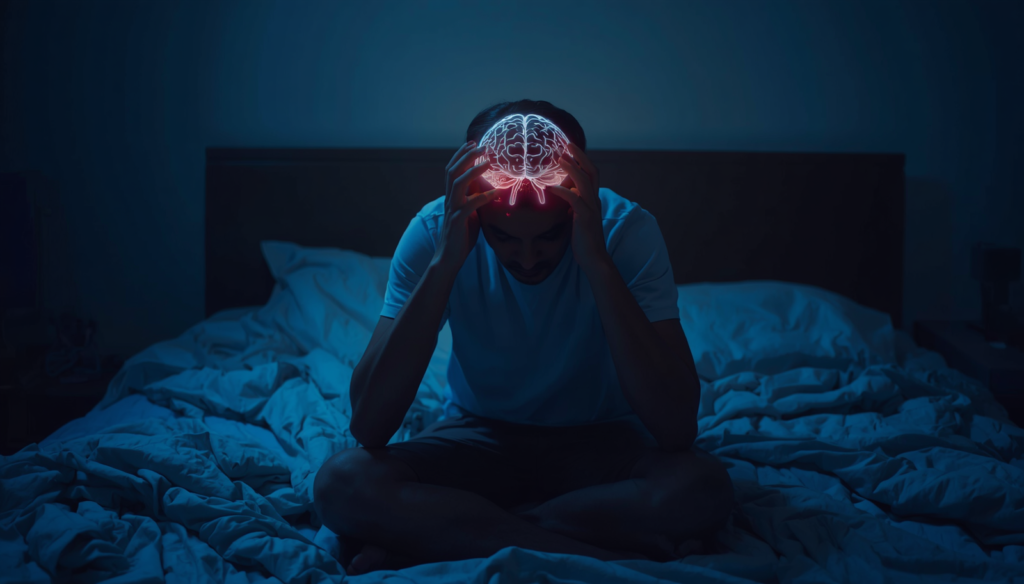
To understand why sleep deprivation is so devastating for mental health, you need to understand what actually happens inside the brain during a bad night.
The Amygdala Goes Into Overdrive
The amygdala is the brain’s threat-detection center — the alarm system that triggers fear, anxiety, and emotional reactivity. In well-rested individuals, the prefrontal cortex (the rational, decision-making part of the brain) keeps the amygdala in check, providing context and proportion to emotional responses.
Sleep deprivation severs this connection. Without adequate sleep, the prefrontal cortex loses its ability to regulate the amygdala — and the amygdala becomes up to 60% more reactive to negative emotional stimuli. Everything feels more threatening, more overwhelming, more catastrophic. Sound familiar? It should — it’s essentially the neurobiology of anxiety.
The Brain’s Emotional Memory System Gets Hijacked
During REM sleep — the dreaming stage — the brain processes emotional memories, essentially “filing” emotional experiences and stripping them of some of their emotional charge. This is why things often feel less upsetting the morning after sleeping on them.
Without adequate REM sleep, this emotional processing doesn’t happen properly. Distressing experiences don’t get filed — they stay raw and accessible, contributing to rumination, emotional dysregulation, and in severe cases, the intrusive memories characteristic of PTSD.
The Brain’s Waste Clearance System Fails
During deep sleep, the brain’s glymphatic system — a waste clearance network — activates and flushes out metabolic byproducts, including amyloid beta and tau proteins associated with Alzheimer’s disease, as well as inflammatory compounds that contribute to neuroinflammation.
When sleep is inadequate, this clearance system doesn’t do its job. Neuroinflammatory compounds accumulate — and neuroinflammation is increasingly recognized as a significant driver of both depression and anxiety.
Stress Hormones Spike
A single night of poor sleep raises cortisol levels the following day by up to 37%. Cortisol is the body’s primary stress hormone — elevated levels drive anxiety, emotional reactivity, and the physical symptoms of stress. Chronic sleep deprivation means chronically elevated cortisol, which creates a persistent low-grade stress state that feeds directly into anxiety and depressive disorders.
The Vicious Cycle: How Sleep and Mental Health Trap Each Other
Here’s where things get particularly difficult for people dealing with mental health challenges: sleep problems and mental health problems trap each other in a vicious cycle that can be extremely hard to break without deliberate intervention.
Depression → Poor sleep → Worsened depression → Worse sleep
Depression disrupts the neurochemical systems that regulate sleep. Poor sleep then worsens the neuroinflammation, emotional dysregulation, and stress hormone levels that drive depression. Which makes sleep worse. Which deepens the depression. And so on.
Anxiety → Hyperarousal → Can’t sleep → More anxiety
Anxiety activates the sympathetic nervous system — the “fight or flight” response — which is fundamentally incompatible with the parasympathetic state required for sleep onset. Being unable to sleep then triggers further anxiety (often about the sleep itself), increasing arousal, and making sleep even harder to achieve.
Breaking this cycle requires addressing both sides simultaneously — not just treating the mental health condition and hoping sleep improves, but actively treating the sleep problem as a primary intervention.
The Most Effective Sleep Interventions for Mental Health
1. Cognitive Behavioral Therapy for Insomnia (CBT-I)
CBT-I is the gold standard treatment for chronic insomnia and is now recommended as the first-line treatment over sleep medication by most major medical organizations — including the American College of Physicians.
CBT-I addresses the thoughts, behaviors, and environmental factors that perpetuate insomnia. It includes techniques like sleep restriction therapy, stimulus control, cognitive restructuring of sleep-related thoughts, and sleep hygiene education.
Multiple studies show CBT-I is more effective than sleep medication for long-term outcomes — and its benefits persist after treatment ends, unlike medication effects that typically disappear when the drug is stopped.
2. Sleep Restriction Therapy
Counterintuitively, one of the most effective treatments for insomnia involves temporarily restricting time in bed to consolidate sleep and rebuild the brain’s sleep drive. This technique — used within CBT-I — produces rapid improvements in sleep efficiency and quality, often within 2–3 weeks.
3. Consistent Sleep and Wake Times
The single most impactful sleep hygiene practice is going to bed and waking up at the same time every day — including weekends. This anchors the circadian rhythm, making it significantly easier to fall asleep and wake up naturally. Even 2 days of “social jet lag” (sleeping in on weekends) can meaningfully disrupt sleep quality for the rest of the week.
4. Morning Light Exposure
Getting 10–15 minutes of natural light within the first hour of waking is one of the most powerful tools for regulating the circadian rhythm and improving sleep onset at night. Morning light suppresses residual melatonin, anchors the wake signal, and sets the circadian timer so that melatonin rises appropriately 14–16 hours later — right when you want to be falling asleep.
5. Temperature Optimization
Core body temperature needs to drop by approximately 1–2°F to initiate and maintain sleep. Keeping the bedroom cool — ideally between 65–68°F (18–20°C) — significantly improves sleep onset and deep sleep quality. A warm shower or bath 1–2 hours before bed paradoxically helps by drawing blood to the skin surface and accelerating core temperature drop.
6. Reducing Evening Blue Light Exposure
Blue light from screens suppresses melatonin production — the hormone that signals the brain it’s time to sleep. Reducing screen exposure in the 2 hours before bed, or using blue-light filtering glasses or screen settings, allows melatonin to rise naturally and improves sleep onset.
7. Address Anxiety Directly Before Bed
Racing thoughts and worry are among the most common causes of sleep onset difficulties. Evidence-based techniques for managing pre-sleep anxiety include:
- Scheduled worry time — dedicating 20 minutes earlier in the evening to writing down worries and potential solutions, so the mind doesn’t need to process them at bedtime
- Progressive muscle relaxation — systematically tensing and releasing muscle groups to activate the parasympathetic nervous system
- 4-7-8 breathing — inhale for 4 seconds, hold for 7, exhale for 8 — shown to rapidly reduce physiological arousal
8. Treat Sleep Apnea
Obstructive sleep apnea — a condition in which the airway collapses repeatedly during sleep, causing repeated micro-arousals — is dramatically underdiagnosed and has profound effects on mental health. Studies show treating sleep apnea with CPAP therapy produces significant improvements in depression and anxiety symptoms — independent of any other treatment.
If you snore loudly, wake unrefreshed despite adequate hours in bed, or have been told you stop breathing during sleep, getting tested for sleep apnea is a high-priority mental health intervention.
Frequently Asked Questions (FAQ)
Q: How much sleep do you actually need for good mental health? A: Research consistently points to 7–9 hours per night for most adults as the range associated with optimal mental health outcomes. Both too little (under 6 hours) and too much (over 9 hours regularly) are associated with increased mental health risk.
Q: Can fixing my sleep cure my depression or anxiety? A: For some people with mild to moderate conditions, improving sleep quality produces dramatic improvements in mental health symptoms. For others, it’s an important component of treatment alongside therapy and/or medication. Treating insomnia has been shown to improve depression outcomes in the majority of cases, making sleep a high-priority target in any mental health treatment plan.
Q: What’s the best sleep position for mental health? A: While sleep position has less impact than sleep quality and duration, sleeping on your side is generally associated with better sleep-disordered breathing outcomes, which indirectly benefits mental health. The most important factor is whatever position allows you to sleep most deeply and restfully.
Q: Do sleep medications help with mental health? A: Sleep medications can provide short-term relief from insomnia but are not recommended for long-term use due to tolerance, dependency risk, and rebound insomnia upon discontinuation. CBT-I produces better long-term outcomes with none of these risks and is now the recommended first-line treatment.
Q: Is melatonin effective for sleep and mental health? A: Melatonin is most effective for circadian rhythm disruption — jet lag, shift work, delayed sleep phase disorder. Its evidence for treating primary insomnia is modest. It’s generally safe in low doses (0.5–1mg) and can be a useful tool for circadian reset, but it’s not a substitute for the behavioral and environmental interventions above.
Q: Can napping help with mental health if I’m sleep deprived? A: Short naps (10–20 minutes) can partially restore cognitive function and mood after a poor night’s sleep. However, longer naps or napping late in the day can reduce sleep pressure and make nighttime sleep harder — potentially worsening the underlying sleep problem.
The Bottom Line
The connection between sleep and mental health is not peripheral — it’s central. Poor sleep doesn’t just accompany depression and anxiety. It drives them, worsens them, and makes them dramatically harder to treat.
The good news is that this relationship works in both directions. Improving sleep quality — through CBT-I, consistent sleep timing, morning light, temperature optimization, and anxiety management — produces real, measurable improvements in mental health outcomes for the majority of people who implement these changes.
If you’re dealing with depression, anxiety, or any mental health challenge and you’re not actively treating your sleep as a priority, you may be fighting with 1 hand tied behind your back.
Sleep isn’t just rest. It’s when your brain heals. Protect it like your mental health depends on it — because it genuinely does.