
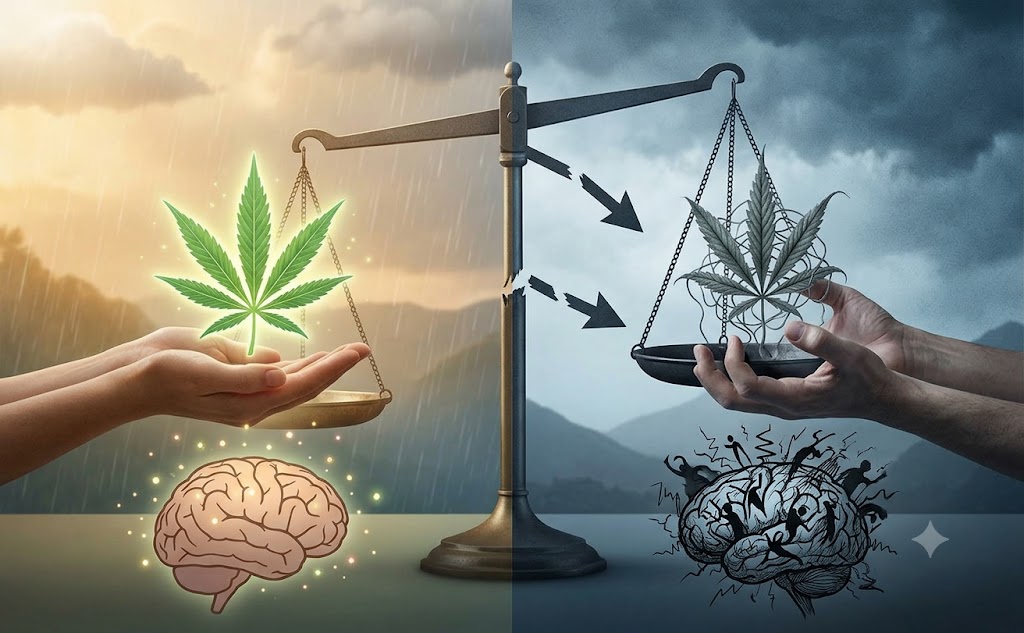
Cannabis for anxiety and depression is one of the most widespread self-medication practices in the world right now — but the largest scientific review ever conducted on the subject just delivered findings that should give every user serious pause.
The study — a sweeping meta-analysis that examined data from hundreds of trials and tens of thousands of participants — found no convincing evidence that medicinal cannabis effectively treats anxiety, depression, or PTSD. Not only that, but researchers warned the drug could actually make symptoms worse in a significant proportion of users.
This isn’t a fringe finding from a prohibitionist think tank. It’s the conclusion of one of the most comprehensive, rigorous reviews of the medicinal cannabis literature ever assembled — and it deserves serious attention.
What the Study Found
The meta-analysis examined data from over 83 studies involving more than 3,000 participants diagnosed with anxiety disorders, depression, PTSD, and other mental health conditions. Researchers analyzed both the effectiveness and the safety of various cannabis products — including CBD, THC, and combined preparations — across these conditions.
The findings were stark:
- No significant benefit was found for cannabis in treating anxiety disorders compared to placebo
- No significant benefit was found for cannabis in treating major depressive disorder
- No significant benefit was found for cannabis in treating PTSD
- Users of THC-containing products showed increased risk of worsening symptoms in several conditions
- Adverse effects were common — including increased anxiety, paranoia, cognitive impairment, and dependency
- The overall quality of evidence was rated as low to very low across most conditions studied
The researchers concluded that the current evidence does not support the use of medicinal cannabis for anxiety, depression, or PTSD — and that the widespread belief in its effectiveness may be significantly outpacing the science.
Why So Many People Believe Cannabis Helps Their Mental Health

If cannabis doesn’t effectively treat anxiety and depression, why do so many people swear by it?
This is genuinely worth understanding — because the disconnect between lived experience and research findings isn’t just about wishful thinking. There are real neurobiological reasons why cannabis feels helpful in the short term, even when it isn’t beneficial — and may be harmful — over time.
Short-Term Relief vs. Long-Term Outcomes
Cannabis — particularly THC — produces immediate psychoactive effects that can temporarily reduce the perception of anxiety and emotional distress. In the short term, users often experience relaxation, reduced ruminative thinking, and a temporary lifting of mood.
The problem: these acute effects don’t translate to therapeutic benefit over time. In fact, regular use often leads to tolerance — requiring more cannabis to achieve the same effect — and rebound anxiety when the drug wears off. Over weeks and months, many regular cannabis users find their baseline anxiety higher than before they started using.
The Endocannabinoid System Disruption
The body has its own endocannabinoid system — a network of receptors that plays a crucial role in regulating mood, stress response, and emotional processing. Regular cannabis use disrupts this system, downregulating natural endocannabinoid production. When users stop or reduce cannabis, the resulting deficiency in natural endocannabinoid activity can manifest as — you guessed it — increased anxiety and depressed mood.
Confirmation Bias and the Illusion of Control
People who use cannabis for anxiety tend to use it during anxious moments. When anxiety naturally subsides — as it always eventually does — the cannabis gets credit. Over time, this creates a powerful conditioned belief that cannabis is managing symptoms, even when the anxiety would have resolved on its own.
The CBD vs. THC Distinction
It’s worth noting that the research picture for CBD specifically is somewhat more nuanced than for cannabis overall. Some evidence suggests CBD may have modest anxiolytic (anxiety-reducing) properties, though the clinical evidence remains limited and inconsistent. The concerning findings in the meta-analysis relate primarily to THC-containing products — which make up the vast majority of what people actually use.
The PTSD Question: More Complex Than It Seems
PTSD deserves special attention because it’s one of the conditions for which medicinal cannabis has been most actively promoted — and for which many veterans, trauma survivors, and advocates have pushed for expanded access.
The research picture for cannabis and PTSD is particularly complicated:
- Some patients report genuine subjective improvement in PTSD symptoms — particularly sleep disturbance and nightmares — with cannabis use
- However, controlled clinical trials have failed to demonstrate significant benefit over placebo
- Cannabis use in PTSD patients is associated with higher rates of cannabis use disorder compared to the general population
- Some evidence suggests cannabis may interfere with the emotional processing that is central to trauma recovery — potentially blunting the effectiveness of evidence-based therapies like EMDR and prolonged exposure therapy
The concern is that cannabis may provide temporary symptom relief while actually impeding the deeper neurological processing that genuine trauma recovery requires.
What Actually Works for Anxiety, Depression, and PTSD
If cannabis isn’t the answer, what is? Here’s a summary of the interventions with the strongest evidence base for each condition:
For Anxiety Disorders
- Cognitive Behavioral Therapy (CBT) — consistently the most effective treatment, with durable long-term results
- SSRIs and SNRIs — first-line medications with strong evidence across multiple anxiety disorders
- Exercise — particularly aerobic exercise, shown to reduce anxiety symptoms comparably to medication in several studies
- Mindfulness-Based Stress Reduction (MBSR) — well-supported for generalized anxiety
- Breathing and nervous system regulation practices — diaphragmatic breathing, box breathing, HRV biofeedback
For Depression
- CBT and behavioral activation — gold-standard psychological treatments
- SSRIs, SNRIs, and other antidepressants — effective for moderate to severe depression
- Exercise — as effective as medication for mild to moderate depression in multiple studies
- Interpersonal therapy (IPT) — particularly effective for depression linked to relationship issues or grief
- Light therapy — highly effective for seasonal affective disorder and other depression subtypes
For PTSD
- Trauma-focused CBT — the most evidence-backed psychological treatment for PTSD
- EMDR (Eye Movement Desensitization and Reprocessing) — strong evidence, particularly for trauma processing
- Prolonged Exposure Therapy — highly effective for reducing PTSD symptom severity
- SSRIs — only FDA-approved medications for PTSD (sertraline and paroxetine)
- Emerging: MDMA-assisted therapy — showing promising results in clinical trials, though not yet widely available
A Note on Harm Reduction
For people who are currently using cannabis for mental health reasons, this research isn’t a reason to feel judged or to quit abruptly. Abrupt cessation of regular cannabis use can itself cause significant anxiety and mood disturbance in the short term.
If you’re using cannabis to manage mental health symptoms and this research concerns you, the most constructive steps are:
- Talk to a mental health professional about evidence-based alternatives for your specific condition
- Don’t quit abruptly if you’re a heavy user — taper gradually and ideally with professional support
- Be honest with yourself about whether cannabis is genuinely helping your symptoms long-term or just providing short-term relief that keeps you from addressing the underlying issue
- Distinguish between CBD and THC — if you’re using cannabis for anxiety, high-THC products are most likely to worsen symptoms over time
Frequently Asked Questions (FAQ)
Q: Does cannabis help with anxiety? A: According to the largest meta-analysis ever conducted on the subject, there is no convincing evidence that cannabis effectively treats anxiety disorders. While it may provide short-term relief, regular use — particularly of THC-containing products — is associated with worsening anxiety over time.
Q: Is CBD different from cannabis for mental health purposes? A: CBD and THC have different mechanisms and different evidence profiles. CBD shows some modest promise for anxiety in early research, though the clinical evidence is still limited. THC — the psychoactive component in most cannabis products — is more clearly associated with potential worsening of anxiety and mood disorders with regular use.
Q: Why do so many people feel that cannabis helps their anxiety if the research says it doesn’t work? A: Short-term relief, confirmation bias, endocannabinoid system disruption creating rebound symptoms, and the natural fluctuation of anxiety all contribute to the perception that cannabis is helping even when long-term outcomes aren’t improving — and may be worsening.
Q: Can cannabis make depression worse? A: Yes — particularly with regular, heavy use of high-THC products. Multiple studies link regular cannabis use to increased rates of depression, and the meta-analysis found no evidence of benefit for depressive disorders.
Q: What about medical marijuana for PTSD specifically? A: While some PTSD patients report subjective improvements — particularly for sleep and nightmares — controlled clinical trials have not demonstrated significant benefit over placebo. There are also concerns that cannabis may interfere with the emotional processing required for trauma recovery.
Q: What should I do if I’ve been using cannabis for mental health and want to stop? A: Talk to a doctor or mental health professional before stopping, especially if you’re a regular user. Abrupt cessation can cause withdrawal symptoms including anxiety and mood disturbance. A gradual taper combined with evidence-based treatment for your underlying condition is the safest approach.
The Bottom Line
The largest scientific review ever conducted on cannabis and mental health has delivered a clear verdict: cannabis for anxiety and depression doesn’t work — and may actively make things worse for a significant number of users.
This doesn’t mean the experiences of people who feel helped by cannabis aren’t real. It means that the short-term relief many people experience doesn’t translate to genuine therapeutic benefit over time — and for many, regular use is quietly deepening the very problems they’re trying to solve.
If you’re struggling with anxiety, depression, or PTSD, the good news is that the evidence-based treatments that actually work — therapy, medication, exercise, structured behavioral interventions — are more accessible than ever. The science has spoken clearly on cannabis.
The question now is whether we’re willing to listen.