If you’ve ever sat down to try meditation, lasted about ninety seconds, and then quietly decided you’re “just not the meditating type” — you’re in good company. Almost everyone who’s ever tried meditation has had that exact experience at least once. The problem usually isn’t you. It’s that most advice about meditation is either too vague (“just clear your mind”) or too demanding (30-minute sessions, silent retreats, apps with hundred-day streaks) to fit into an actual, busy, distractible human life.
Meditation doesn’t have to look like any of that. At its core, it’s simply the practice of paying attention on purpose, without judging what shows up. Built the right way, it can become one of the steadiest, most portable tools you have for calming a racing mind — and it can take less time than making a cup of coffee.
What Meditation Actually Is (And Isn’t)
A lot of people avoid meditation because they think it means successfully emptying their mind of all thought. It doesn’t, and that expectation sets almost everyone up to feel like they’re failing at it from the very first attempt. This misunderstanding alone stops more people from sticking with meditation than any lack of time or discipline ever does, because it turns a simple, forgiving practice into a test you’re constantly failing.
Meditation is really just noticing. You notice your breath, a sound, a sensation in your body, or a thought — and when your attention inevitably wanders (because it will, every single time, for every person who has ever meditated), you gently bring it back. That’s the entire practice. The wandering isn’t a failure of meditation. The wandering, and the returning, is the meditation.
This distinction matters because it changes what “doing it right” looks like. You’re not trying to achieve a blank, silent mind. You’re building the small, repeatable skill of noticing when you’ve drifted and coming back — a skill that, it turns out, transfers directly into calming down during a stressful meeting, an argument, or a spiral of late-night worry.
It also helps to separate meditation from relaxation, even though the two often overlap. Relaxation is a byproduct that sometimes shows up during meditation, but it isn’t the goal, and chasing it directly can backfire. If you sit down determined to feel calm and instead feel restless or irritable, it’s easy to conclude the meditation “didn’t work.” In reality, noticing that restlessness without needing to fix it is itself a successful practice. The skill you’re building is closer to steadiness than to calm — the ability to stay present with whatever is actually happening, rather than only being able to tolerate the moments that feel pleasant.
Start With Two Minutes, Not Twenty
The single biggest reason people quit meditation is starting with a session length that only works on their best day. Twenty minutes of stillness sounds great in theory and becomes impossible the first time you’re running late, overtired, or mentally scattered.
Instead, start absurdly small: two minutes, once a day. Set a timer, sit or lie down comfortably, and simply follow your breath in and out. When your mind wanders — and it will, probably within the first ten seconds — just notice that it wandered and return your attention to your breath. That’s a complete, successful session.
Two minutes feels almost too easy to matter, and that’s exactly the point. A tiny practice you actually do every day will build far more skill over a month than an ambitious practice you attempt three times and abandon. Once two minutes feels natural, which usually takes a couple of weeks, you can let the time grow on its own — five minutes, then ten — without ever forcing it.
There’s also a psychological reason small sessions work better than people expect. Every time you complete your two minutes, even on a day you didn’t feel like it, you’re reinforcing the identity of someone who meditates — not someone who’s trying to meditate, or meaning to start again someday, but someone who actually does it. That identity shift tends to matter more for long-term consistency than any technique or app. A single missed twenty-minute session can feel like proof the whole thing isn’t working. A completed two-minute session, even an imperfect one, quietly proves the opposite.
Anchor Your Practice to Something You Already Do
The habits that survive aren’t the ones we remember to do — they’re the ones stitched onto something already automatic in our day. This works just as well for meditation as it does for any other habit.
Pick a moment that already happens reliably: right after you sit down with your morning coffee, right before you open your laptop, or right after you get into bed at night. Attach your two minutes there, every time, in the same spot. Removing the decision of “when should I meditate today” removes most of the friction that causes people to skip it.
If you’re also trying to build other small daily habits alongside this one, our post on how to build a habit that sticks covers the science behind why tiny, anchored habits outlast big, ambitious ones. The same principle applies whether the habit is meditation, journaling, or a stretch routine — attach it to something automatic, keep it small, and let consistency do the rest of the work.
You Don’t Need to Sit Cross-Legged in Silence
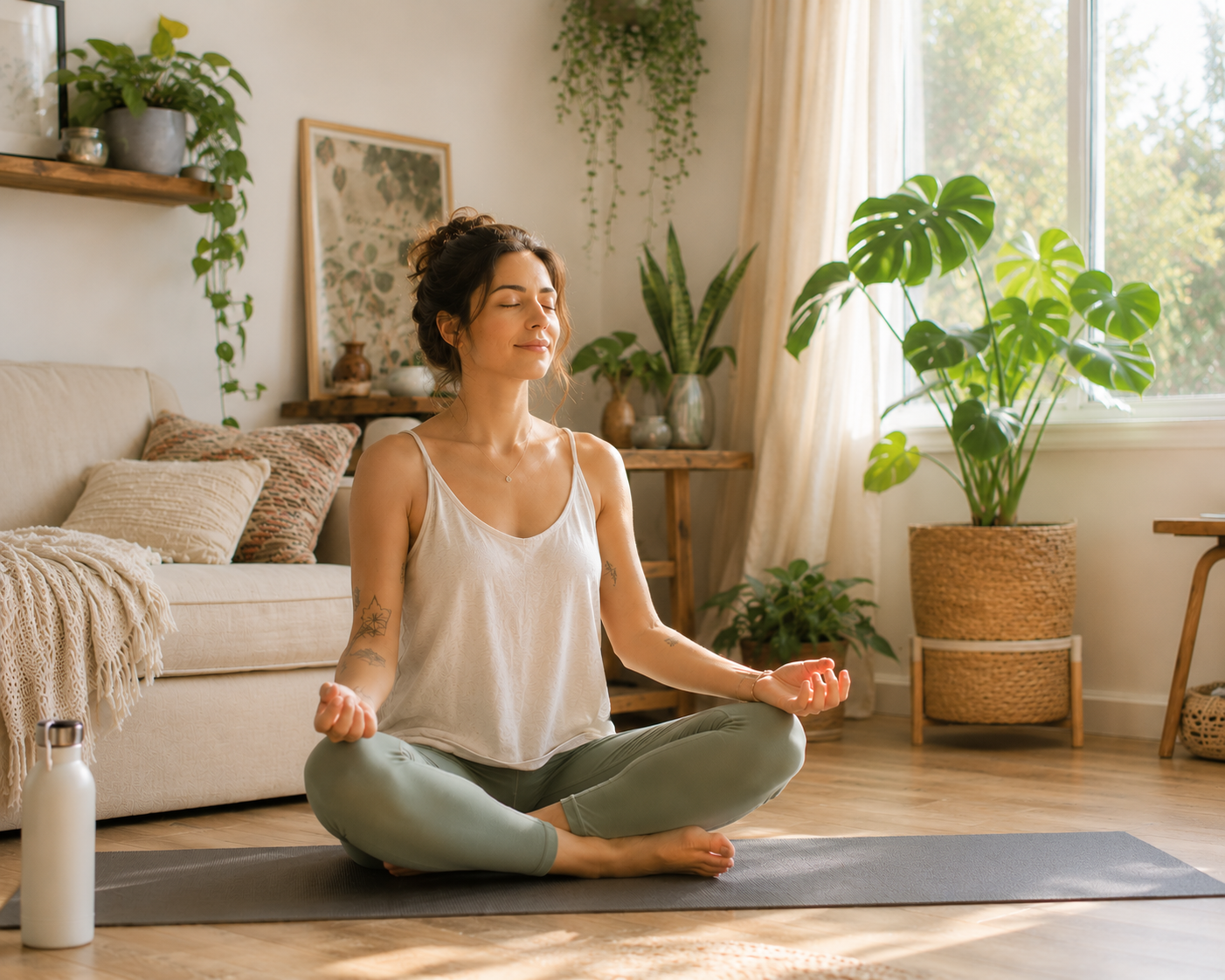
One of the more persistent myths about meditation is that it requires a specific posture, a quiet room, and total stillness. In reality, you can meditate sitting in a chair, lying down, standing in line, or walking slowly through your neighborhood. What matters is the quality of attention, not the position of your body.
If sitting still feels uncomfortable or even agitating at first, a body-based approach can be an easier entry point than trying to sit quietly with your thoughts right away. Our guide to somatic exercises for beginners offers gentle, movement-based ways to release physical tension, which can make it much easier to settle into stillness once you do sit down to meditate.
Notice What Happens in Your Body, Not Just Your Mind
Meditation is often framed as a purely mental exercise, but a lot of its calming effect comes through the body. Slow, steady breathing during meditation activates the parasympathetic nervous system — the part of your body responsible for rest and recovery — which is part of why even a short session can leave you feeling noticeably calmer afterward.
This connection between breath, calm, and the body’s own regulation system runs deeper than most people realize. If you’re curious about the physiology behind why slow breathing has such an outsized calming effect, our piece on improving vagus nerve tone naturally explains the mechanism and offers other simple ways to support it alongside your meditation practice.
Expect Distraction, Restlessness, and Days You Don’t Want To
There will be sessions where your mind won’t settle for even a second, where two minutes feels like twenty, or where you simply don’t feel like doing it at all. This is normal, and it happens to experienced meditators just as much as beginners.
On those days, aim for the smallest possible version rather than skipping entirely: a single slow breath, a few seconds of noticing the feeling of your feet on the floor, or simply sitting down and deciding that counts. Protecting the habit from becoming all-or-nothing is often more valuable long-term than any single “good” session.
It also helps to decide, in advance, what your minimum version looks like — before you’re in the middle of a restless or unmotivated day trying to negotiate with yourself. Write it down somewhere you’ll see it, or simply commit to it mentally now: “even on my worst day, I will take one slow breath and call it done.” Deciding this ahead of time removes the moment of willpower that so often causes people to skip entirely rather than do a smaller version.
According to guidance from the National Center for Complementary and Integrative Health, meditation has been studied for its potential to reduce stress, improve focus, and support emotional wellbeing when practiced consistently over time — which underscores why showing up in small, imperfect ways matters more than any single perfect session.
Let the Practice Change Shape Over Time
A meditation practice that works for you during a calm month might feel different during a stressful one, and that’s completely fine. Some weeks you might only manage your two-minute anchor habit. Other weeks you might naturally want to sit longer, add a guided recording, or try a walking meditation instead.
Treat these shifts as the practice adapting to your life, not as failures of consistency. The goal was never to build a rigid ritual — it was to build a reliable way of returning to the present moment, in whatever form fits the day you’re actually having. Some of the most consistent long-term meditators aren’t the ones with the most disciplined schedule; they’re the ones who stopped treating a shrinking or shifting practice as a sign of failure and simply kept showing up in whatever small way the day allowed.
🧘 Want to make your practice feel more intentional?
A few small sensory cues — sound, scent — can help signal to your brain that it’s time to slow down. A singing bowl or a simple aromatherapy diffuser are two easy additions to a meditation space.
See more picks in our 10 Wellness Products for Self-Care roundup.
FAQs
How long should a beginner meditate for? Two to five minutes is a realistic starting point. Consistency at a small, sustainable length matters far more than session length.
What if I can’t stop thinking during meditation? That’s normal and expected — meditation isn’t about stopping thoughts, but about noticing when your attention wanders and gently returning it.
Do I need an app or special training to meditate? No. A quiet couple of minutes and your own breath are enough to begin. Apps and guided recordings can help, but they aren’t required.
Can meditation help with anxiety or stress? Many people find it helpful as part of a broader approach to managing stress, though it isn’t a replacement for professional support when needed.
Conclusion
Meditation doesn’t need to look like a silent retreat or a 30-minute ritual to be worthwhile. It can be two honest minutes a day, anchored to something you already do, built around noticing rather than achieving stillness. Start small, expect your mind to wander, and let the practice grow at its own pace — that’s how a meditation habit actually survives real life.
Disclaimer: This article is for general informational purposes only and is not a substitute for professional medical, psychological, or mental health advice. If you’re struggling with stress, anxiety, or your mental health, please reach out to a licensed therapist, counselor, or healthcare provider who can offer guidance suited to your specific situation.