
Movement benefits against depression are far more powerful than most people realize — and a growing body of research is making the case that exercise may be one of the most effective antidepressants ever discovered.
That’s not a motivational poster statement. That’s the conclusion of hundreds of peer-reviewed studies spanning decades of research across millions of patients worldwide.
Yet despite this evidence, exercise remains one of the most underutilized tools in mental health treatment. Most people dealing with depression reach for medication first, therapy second, and movement last — if at all. And while medication and therapy are genuinely valuable, the science suggests we’ve been drastically underselling what regular physical activity can do for a struggling mind.
Here’s everything you need to know about how movement fights depression — and how to actually use it.
What the Research Says About Exercise and Depression
The evidence connecting physical activity to improved mental health is some of the most consistent in all of medicine. Here’s a snapshot of what the research shows:
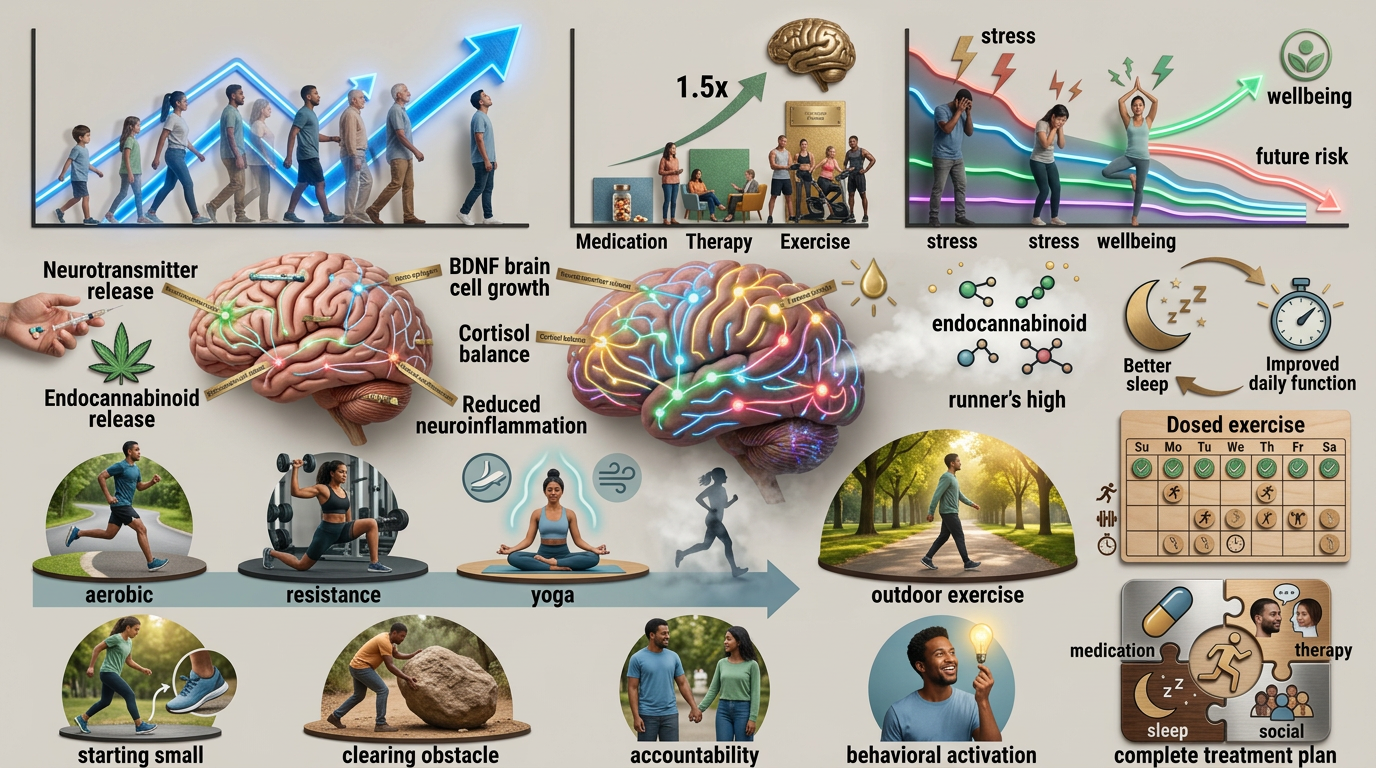
- A 2023 meta-analysis published in the British Journal of Sports Medicine — analyzing 218 studies and over 14,000 participants — found that exercise was 1.5 times more effective than leading medications and cognitive behavioral therapy (CBT) for reducing symptoms of depression and anxiety
- 150 minutes of moderate exercise per week reduced depression risk by 43% in a large-scale study of over 33,000 adults followed for 11 years
- People with depression who exercised regularly were 26% less likely to develop depression again compared to those who didn’t
- Even 1 hour of physical activity per week — any type, any intensity — was associated with preventing 12% of future depression cases
- Exercise produces antidepressant effects that appear within 2–4 weeks — comparable to the onset time of most antidepressant medications
These aren’t marginal effects. They’re clinically significant numbers that rival — and in some analyses exceed — the effects of first-line pharmaceutical treatments.

Why Exercise Works as an Antidepressant: 6 Biological Mechanisms
Understanding why exercise fights depression helps explain how to use it most effectively. There are at least 6 distinct biological pathways through which movement improves mood.
1. Neurotransmitter Regulation
Exercise increases the production and availability of serotonin, dopamine, and norepinephrine — the exact neurotransmitters that most antidepressant medications target. Unlike medication, which artificially alters neurotransmitter levels, exercise stimulates the brain’s own production systems — creating a more natural, self-sustaining effect.
2. BDNF — The Brain’s “Miracle Grow”
Brain-derived neurotrophic factor (BDNF) is a protein that promotes the growth and survival of brain cells, particularly in the hippocampus — the brain region most directly associated with mood regulation and memory. Depression is associated with reduced hippocampal volume and decreased BDNF levels. Exercise powerfully stimulates BDNF production, essentially helping the brain repair and rebuild itself.
3. HPA Axis Regulation
The hypothalamic-pituitary-adrenal (HPA) axis governs the body’s stress response and cortisol production. In people with depression, this system is often dysregulated — chronically overactive, flooding the body with stress hormones. Regular exercise recalibrates the HPA axis, reducing baseline cortisol and making the stress response more proportionate and manageable.
4. Neuroinflammation Reduction
Chronic low-grade inflammation — particularly neuroinflammation — is increasingly recognized as a key driver of depression. Multiple studies show elevated inflammatory markers in depressed individuals. Exercise has potent anti-inflammatory effects, reducing the neuroinflammatory burden that contributes to depressive symptoms.
5. Endorphin and Endocannabinoid Release
The famous “runner’s high” is real — but it’s not just endorphins. Research now shows that the post-exercise mood boost is driven significantly by the endocannabinoid system — the same system targeted by cannabis. Exercise causes a surge in naturally produced endocannabinoids, producing feelings of calm, euphoria, and reduced anxiety that can last for hours after a workout.
6. Sleep Improvement
Depression and poor sleep exist in a vicious cycle — each making the other worse. Exercise is one of the most effective non-pharmacological interventions for sleep quality. Better sleep directly reduces depressive symptoms, making this a particularly powerful indirect pathway.
Which Type of Exercise Works Best for Depression?
Here’s the good news: the research suggests that virtually all forms of exercise help with depression. You don’t need to do a specific type to get the mental health benefit. That said, different types offer slightly different advantages.
Aerobic Exercise
Cardiovascular exercise — running, cycling, swimming, brisk walking, dancing — produces the strongest and most immediate mood-lifting effects. This is likely due to the robust endorphin and endocannabinoid release triggered by sustained aerobic effort.
Best for: Acute mood improvement, anxiety reduction, immediate stress relief
Resistance Training
Strength training has emerged as a surprisingly powerful antidepressant in its own right. A 2018 meta-analysis of 33 randomized controlled trials found that resistance training significantly reduced depressive symptoms across all populations studied — including people with mild, moderate, and severe depression.
Best for: Self-efficacy, long-term mood stability, body image improvement
Yoga and Mind-Body Exercise
Yoga combines physical movement with breathwork, mindfulness, and nervous system regulation — making it uniquely effective for depression with a significant anxiety component. Multiple studies show yoga reduces cortisol, improves HRV, and produces meaningful reductions in depressive symptoms.
Best for: Depression combined with anxiety, high stress, sleep disturbance
Outdoor Exercise
Research consistently shows that exercising outdoors — particularly in green spaces — produces greater mental health benefits than identical exercise indoors. The combination of physical activity, natural light, and nature exposure creates a synergistic effect on mood.
Best for: Maximizing the mood benefit of any given exercise session
How Much Exercise Do You Need to Fight Depression?
Based on the current evidence, here are the dosing guidelines that produce meaningful antidepressant effects:
| Exercise Type | Frequency | Duration | Effect |
|---|---|---|---|
| Moderate aerobic (brisk walk, cycling) | 3–5 days/week | 30–45 min | Strong antidepressant effect |
| Vigorous aerobic (running, HIIT) | 3 days/week | 20–30 min | Strong antidepressant effect |
| Resistance training | 2–3 days/week | 30–45 min | Moderate-strong antidepressant effect |
| Yoga | 2–3 days/week | 45–60 min | Moderate antidepressant effect |
| Any movement | 1+ days/week | Any duration | Some benefit vs. no exercise |
The sweet spot for most people appears to be 3–5 sessions per week of moderate-intensity exercise, for a total of 150–200 minutes per week. This is consistently the range that produces the strongest antidepressant effects in the research.
But here’s the critical caveat: any movement is better than none. For someone in the depths of depression, the goal isn’t 5 workouts a week. It’s 1. Then 2. Then 3.
The Biggest Barrier: Depression Makes Exercise Hard
Here’s the cruel paradox of using exercise for depression: the very symptoms of depression — low energy, lack of motivation, loss of pleasure, social withdrawal — make exercise feel nearly impossible.
This is not a willpower problem. It’s a neurobiological one. Depression alters the brain’s reward circuitry, making activities that would normally feel rewarding feel pointless or overwhelming. Telling a depressed person to “just go for a run” without addressing this barrier is like telling someone with a broken leg to “just walk it off.”
So how do you actually start moving when depression has drained your motivation tank?
Start absurdly small. Not 30 minutes. Not even 15. Start with 5 minutes. Walk to the end of the street and back. Do 10 push-ups. Put on music and move around your kitchen for 1 song. The goal at the beginning isn’t fitness — it’s creating a crack in the inertia.
Remove every possible friction point. Sleep in your workout clothes. Keep your shoes by the door. Choose an activity that requires zero preparation. The fewer decisions between you and moving, the better.
Use behavioral activation. This is a core technique in cognitive behavioral therapy — doing the activity before you feel motivated to do it, knowing that the motivation often comes after starting, not before. Act first, feel better second.
Lean on accountability. A workout partner, a group class, a coach, or even a public commitment dramatically increases follow-through for people fighting depression.
Give yourself credit for showing up. A 10-minute walk when you’re depressed takes more psychological effort than an hour-long run when you’re feeling great. Recognize that.
Exercise as Part of a Broader Treatment Plan
To be clear: exercise is not a replacement for professional mental health treatment. For moderate to severe depression, medication and therapy remain important, evidence-based interventions that save lives.
What the research supports is this: exercise should be an active part of every depression treatment plan — not an afterthought, not a vague suggestion, but a specific, structured component with clear frequency and intensity targets.
The most effective approach combines:
- Medication (when indicated) to stabilize neurochemistry
- Therapy (CBT, ACT, or others) to address thought patterns and behavior
- Exercise to drive neurobiological change and build resilience
- Sleep optimization to support recovery
- Social connection to counteract withdrawal and isolation
Exercise doesn’t replace the other components. It amplifies them.
Frequently Asked Questions (FAQ)
Q: How quickly does exercise improve depression symptoms? A: Most people notice mood improvements within 1–2 weeks of starting regular exercise. Significant reductions in depressive symptoms typically become apparent within 4–8 weeks — comparable to the onset time of antidepressant medications.
Q: Can exercise replace antidepressants? A: For mild to moderate depression, research suggests exercise can be as effective as antidepressant medication for many people. For moderate to severe depression, it’s best used alongside medication and therapy rather than as a replacement. Never stop prescribed medication without consulting your doctor.
Q: What’s the best exercise for someone who has never worked out? A: Walking. It requires no equipment, no experience, no gym membership, and no specific fitness level. Starting with a 10–15 minute walk daily and gradually building from there is one of the most evidence-backed approaches for using exercise to combat depression.
Q: Does the intensity of exercise matter for depression? A: Research shows benefits across a wide range of intensities — from gentle walking to vigorous running. Moderate intensity (brisk walking, light cycling) appears to hit the sweet spot of effectiveness and sustainability for most people. The best intensity is the one you can maintain consistently.
Q: Is outdoor exercise better than indoor exercise for depression? A: Research consistently shows outdoor exercise produces greater mood benefits than indoor exercise, likely due to natural light exposure, nature contact, and sensory stimulation. If possible, take your workouts outside — even occasionally.
Q: Can exercise prevent depression from coming back? A: Yes — the evidence here is particularly strong. People who maintain regular exercise after recovering from depression have significantly lower relapse rates. Exercise appears to build neurobiological resilience that makes the brain less vulnerable to future depressive episodes.
The Bottom Line
The evidence is clear and compelling: movement is one of the most powerful tools available for fighting depression. It works through 6 distinct biological pathways, produces effects comparable to medication, and builds long-term resilience against future episodes.
The challenge isn’t scientific — it’s behavioral. Getting a depressed brain to initiate movement is genuinely hard. But the research also tells us that even small amounts of movement matter, that the motivation often follows the action rather than preceding it, and that every session — no matter how short — is doing something real inside the brain.
If you’re struggling with depression, movement won’t fix everything. But it might be the thing that makes everything else a little more possible.
Start with 5 minutes. Just 5 minutes. And go from there.