
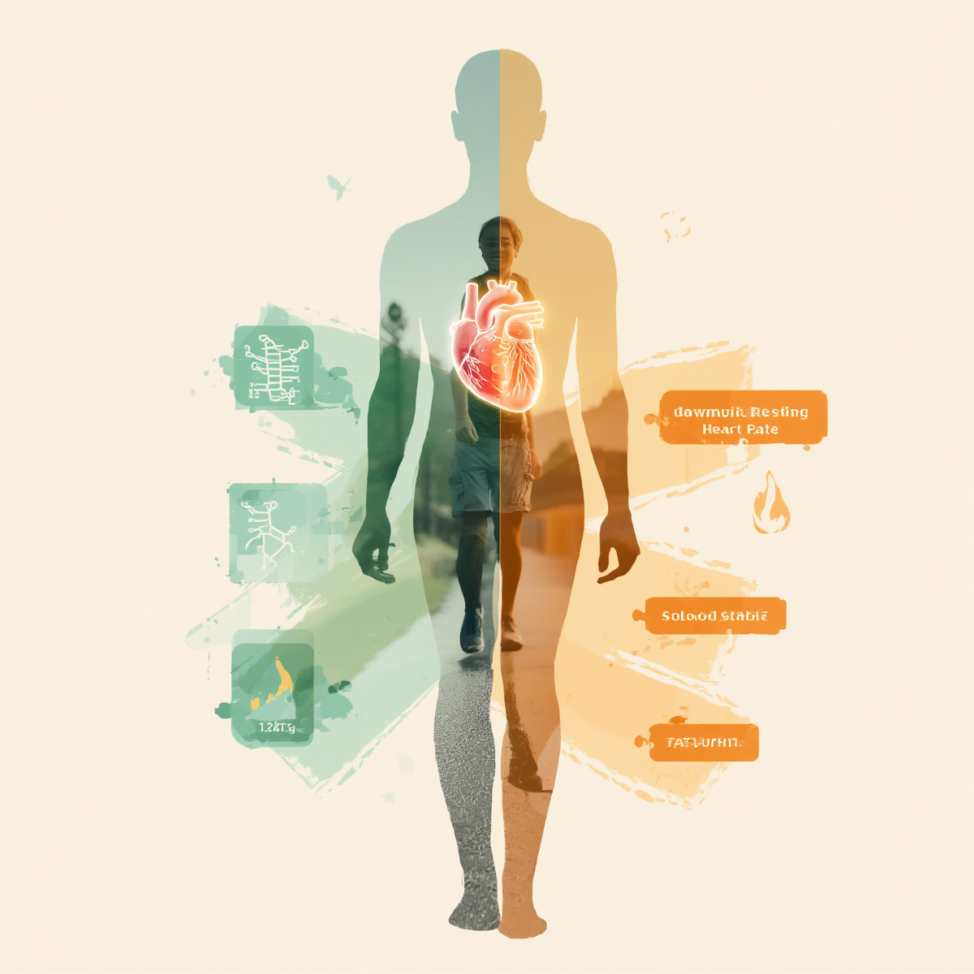
What happens to your metabolism after 6 weeks of walking is genuinely surprising — especially if you’ve been told you need a grueling gym routine to see real results. The truth is, consistent daily walking over 6 weeks triggers changes deep inside your cells that most people never give walking credit for.
Not “I lost 3 pounds” changes. We’re talking about your body fundamentally shifting how it produces energy, regulates blood sugar, and burns fat. And unlike crash diets or intense exercise programs, these changes actually stick.
If you’ve recently started walking — or you’re thinking about it — this article will show you exactly what’s happening inside your body at each stage, why the 6-week mark is special, and how to make the most of every single walk.
Why 6 Weeks? The Timeline That Makes Walking Work
Most people quit a new exercise habit within 2 weeks because they don’t feel dramatically different yet. That’s actually normal — your body is still in adjustment mode.
Here’s what the timeline really looks like:
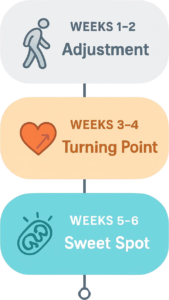
Weeks 1–2: The adjustment phase. Your muscles are sore, your energy dips after walks, and your body is mostly just getting used to the new demand. You might feel more tired than usual. This is not failure — this is your body waking up.
Weeks 3–4: The turning point. Your heart doesn’t have to work as hard at the same pace. Your breathing becomes easier. You start recovering faster. Inside your cells, your muscles are getting better at pulling fuel from your blood during movement — you’re becoming more insulin sensitive without even realizing it.
Weeks 5–6: The sweet spot. This is where the science gets exciting. By now, your cardiovascular system has fully adapted, your resting heart rate has likely dropped a few beats per minute, and your metabolism has undergone what researchers call “metabolic remodeling” — your body has genuinely changed how it processes fuel.
Clinical studies use the 6-week window for good reason: it’s the point where the benefits show up in blood work, not just in how you feel.
5 Real Changes Happening Inside Your Body
1. Your cells become dramatically more responsive to insulin
One of the most powerful things walking does — and almost nobody talks about it — is improve insulin sensitivity.
Here’s why that matters: insulin is the hormone that unlocks your cells so they can absorb glucose (sugar) from your blood. When your cells stop responding well to insulin — a state called insulin resistance — your blood sugar stays elevated, your body pumps out more insulin, and you end up storing fat more easily, especially around your belly.
When you walk, your working muscles pull glucose directly from your bloodstream without needing insulin to do it. Do that repeatedly over 6 weeks and your cells literally become more responsive — they need less insulin to do the same job. Clinical research on previously sedentary adults confirms this: just 6 weeks of regular aerobic walking significantly reduces markers of insulin resistance, even without major weight loss.
The practical result? More stable energy through the day, fewer sugar cravings, and a metabolism that works with you instead of against you.
2. Your body gets better at burning fat for fuel
Think of your body like a hybrid car that runs on 2 fuels: glucose (the fast-burning kind) and fat (the slow, steady kind). When you’re sedentary, your body leans heavily on glucose and barely taps into fat — partly because it doesn’t need to, and partly because your cells aren’t trained to do it efficiently.
6 weeks of consistent walking changes that. Your mitochondria — the tiny energy generators inside every cell — become more efficient at converting stored fat into usable energy. This is called improved fat oxidation, and it’s why many people notice they feel more energized throughout the day around the 6-week mark. Your body has learned to tap its own fat stores instead of constantly demanding its next meal.
This also helps explain why walking, done consistently, produces slow but real body composition changes even when the scale doesn’t budge dramatically.
3. Your mitochondria multiply and get stronger
Here’s a remarkable fact: regular aerobic exercise — including walking — can actually cause your body to create more mitochondria. The scientific term is mitochondrial biogenesis, but the plain-English version is this: your cells build more energy generators in response to the consistent demand you’re placing on them.
More mitochondria means more capacity to produce energy, more endurance, and less fatigue during daily activities. You might notice this as being able to carry groceries up stairs without getting winded, or walking the same route faster without it feeling harder. That’s not just fitness — that’s cellular adaptation happening in real time.
4. Your heart works less hard to do the same job
After 6 weeks of regular walking, your heart becomes measurably more efficient. Your resting heart rate drops (sometimes by 3 to 5 beats per minute or more), and your heart rate at a given walking pace is lower than it was on day 1. This is your cardiovascular system adapting to the training load.
This matters for metabolism because a more efficient heart delivers oxygen to your muscles more effectively — which means your muscles can work harder and longer before fatiguing. And muscles that can sustain activity longer burn more total energy over time.
5. Your blood sugar peaks get smaller and smoother
Every time you eat carbohydrates, your blood sugar rises. The size and duration of that rise matters — big spikes followed by sharp crashes are what drive hunger, cravings, energy dips, and fat storage.
After 6 weeks of walking, particularly if you include short walks after meals, your body handles those glucose spikes far better. Your muscles are primed to absorb glucose quickly, your insulin sensitivity is improved, and the overall curve of your blood sugar response throughout the day becomes much smoother. Research has shown that even a 10–15 minute walk after eating can significantly reduce post-meal blood sugar spikes.
4 Ways to Get More From Your Walks
Walking is great. Intentional walking is better. Here’s how to maximize the metabolic upgrade:
Walk after meals — even just 10 minutes
A 10 to 15 minute walk within 30 minutes of eating is one of the most effective metabolic tools available. It blunts the glucose spike that follows a meal by putting your muscles to work right when your blood sugar is rising. You don’t need speed — a gentle stroll is enough.
Try it after dinner for 2 weeks and watch how much more stable your energy feels in the evenings.
Add intervals to challenge your metabolism further
You don’t have to walk at one steady pace the entire time. Alternating between a brisk pace and an easy recovery pace — known as interval walking — pushes your heart and muscles harder, keeps your metabolic rate elevated longer after the walk, and builds fitness faster. We cover the full research-backed protocol in our guide to the Japanese walking method, which uses 3 minutes fast and 3 minutes easy for 30 minutes total.
Use hills or inclines
Walking on an incline — whether on a hill outside or a treadmill set to a 3–5% grade — dramatically increases how many calories your body burns without requiring you to go faster. Even a gentle slope adds meaningful metabolic demand. Stairs work too.
Try “walking snacks” if you can’t do 30 minutes at once
Research confirms that 3 separate 10-minute walks spread through the day produce similar metabolic benefits to one continuous 30-minute walk. If your schedule is packed, break it up — 10 minutes in the morning, 10 after lunch, 10 after dinner. Your metabolism doesn’t care that it wasn’t all at once.
Real-World Examples of the 6-Week Shift
Sandra, 52, office worker. Sandra started walking 25 minutes every morning before work. By week 6 her fasting blood sugar — which her doctor had flagged as borderline — had dropped to a healthy range without any dietary changes. Her doctor called it “impressive for just walking.”
David, 44, shift worker. David couldn’t do mornings, so he walked for 15 minutes after dinner every night. At the 6-week mark, he noticed he stopped waking up at 2 a.m. craving snacks — a direct result of more stable blood sugar through the evening.
Rita, 67, recently retired. Rita started with 15-minute flat walks and added a small hill by week 3. By week 6 she was walking 40 minutes without stopping and her resting heart rate had dropped from 78 to 71. “It’s the first exercise I’ve ever stuck with,” she said.
What to Eat to Support Your Metabolic Transformation
Walking creates the metabolic foundation. What you eat builds on top of it. The best foods to pair with a 6-week walking routine are ones that keep blood sugar steady, reduce inflammation, and fuel your muscles without overloading them.
Start with your first meal of the day — see our guide to anti-inflammatory breakfast foods that support exactly this kind of metabolic shift. And don’t underestimate the role that stress plays in your results — elevated cortisol actively fights the fat-burning benefits of walking, which is why it’s worth reading our breakdown of cortisol and belly fat alongside your walking routine.
Frequently Asked Questions
Will my metabolism slow down after 6 weeks? Some research shows that very intense exercise can cause the body to compensate by burning fewer calories elsewhere. Walking is generally low-impact and sustainable, making it far less likely to trigger that kind of compensation response. Most people find their energy and calorie burn continue improving past the 6-week mark if they keep going.
How many steps do I actually need? The 10,000-step target is a marketing figure, not a scientific one. Metabolic benefits start showing up with as little as 30 minutes of brisk, continuous movement — or three 10-minute sessions spread through the day. For a full breakdown of the research, see our article on how many steps a day you actually need.
Can walking help me lose weight if I don’t change my diet? Walking alone tends to produce modest weight loss compared to combining it with dietary changes. But even if the scale barely moves, you’re likely losing visceral fat (the dangerous kind around your organs) and gaining muscle tone — both of which are critical for long-term metabolic health and are far more meaningful than the number on a scale.
What if I miss a few days? Missing 1 or 2 days doesn’t undo your progress. The metabolic adaptations built over 6 weeks are persistent — they don’t vanish overnight. Just pick back up where you left off. Consistency over weeks and months matters far more than perfection on any given day.
Do I need to walk fast? A moderate pace — where you’re breathing noticeably but can still hold a conversation — is enough to drive real metabolic change. Brisk walking produces better results than a very slow stroll, but you don’t need to power-walk until you’re gasping. Find a pace that feels like a 6 or 7 out of 10 effort.
Does the time of day matter? Not as much as consistency does. Morning walks have a slight edge for blood sugar regulation (you’re in a fasted state), and post-meal walks have a specific advantage for blunting glucose spikes. But the best time to walk is whichever time you’ll actually do it every day.
The Bottom Line
What happens to your metabolism after 6 weeks of walking isn’t subtle — it’s a genuine physiological shift. Your cells become more insulin sensitive, your body burns fat more efficiently, your mitochondria multiply and strengthen, your heart works less hard, and your blood sugar stabilizes throughout the day.
None of this requires a gym, a trainer, or a perfect diet. It requires consistency — 30 minutes, most days of the week, for 6 weeks. The first 2 weeks will feel like effort. By week 6, it will feel like your new normal.
Start this week. Your metabolism is already waiting to respond.
This article is for educational purposes only and does not constitute medical advice. Always consult with a healthcare professional before starting any new exercise program, especially if you have a pre-existing health condition.