Sleep optimization 2026 is no longer a niche biohacker obsession — it has officially crossed into mainstream health priority territory, and the wearable technology revolution is a big reason why.
For decades, sleep was the most neglected pillar of health. Diet and exercise had billion-dollar industries built around them. Sleep got a mattress commercial and a reminder to “get 8 hours.” But something fundamental has shifted. Between the explosion of sleep-tracking wearables, a surge of research exposing just how catastrophic poor sleep is for health, and a cultural reckoning with burnout and chronic fatigue — sleep has finally earned its seat at the health table.
Today, millions of people are wearing devices to bed, tracking their REM cycles, monitoring their heart rate variability overnight, and making lifestyle decisions based on their sleep scores. The Oura Ring has become a status symbol in wellness circles. WHOOP has millions of subscribers optimizing their recovery. And Apple Watch sleep data is influencing how people structure their entire days.
But here’s the problem: most people are collecting sleep data without really knowing what to do with it. And many of the popular “sleep hacks” circulating online are either oversimplified, inaccurate, or actively counterproductive.
So let’s cut through the noise. Here’s what sleep optimization actually means, what the science says, and the 10 most effective strategies for genuinely improving your sleep quality.
Why Sleep Optimization Matters More Than Most People Realize
Before getting into the how, it’s worth establishing the why — because most people still significantly underestimate just how central sleep is to virtually every dimension of health.
Here’s what the research shows happens when sleep is consistently poor or inadequate:
- Cognitive performance: Just 17 hours of wakefulness produces cognitive impairment equivalent to a blood alcohol level of 0.05% — the legal limit in many countries. After 24 hours, it’s equivalent to 0.1% BAC — legally drunk.
- Metabolic health: Sleeping less than 6 hours per night increases the risk of type 2 diabetes by 37% and is associated with significant weight gain over time
- Cardiovascular risk: Short sleepers (less than 6 hours) have 20% higher risk of heart attack and 15% higher risk of stroke than those sleeping 7–8 hours
- Immune function: A single night of 4 hours of sleep reduces natural killer cell activity by 70% — the immune cells responsible for fighting viral infections and cancer cells
- Mental health: Chronic sleep deprivation increases risk of depression by 50% and anxiety disorders by up to 300%
- Longevity: People consistently sleeping 7–8 hours per night live measurably longer than both short sleepers (under 6 hours) and long sleepers (over 9 hours)
- Hormone regulation: Poor sleep disrupts growth hormone release, testosterone production, cortisol regulation, and insulin sensitivity — affecting everything from muscle building to fat storage to stress resilience
These aren’t marginal effects. Sleep deprivation is 1 of the most potent disruptors of human health available — and optimizing sleep quality is 1 of the highest-leverage health investments you can make.
What Sleep Optimization Actually Means
“Sleep optimization” is a term that gets thrown around a lot — but what does it actually mean in practice?
Genuine sleep optimization involves 4 core dimensions:
1. Duration — Are you getting enough total sleep? (Most adults need 7–9 hours) 2. Timing — Is your sleep aligned with your natural circadian rhythm? 3. Quality — Are you getting adequate amounts of deep (slow-wave) sleep and REM sleep? 4. Consistency — Are you sleeping and waking at consistent times, or does your schedule vary significantly?
Most people focus exclusively on duration — “did I get 8 hours?” — while ignoring the other 3 dimensions. But 8 hours of fragmented, poorly-timed sleep can leave you feeling worse than 6.5 hours of high-quality, well-timed, consistent sleep.
True sleep optimization addresses all 4 dimensions simultaneously.
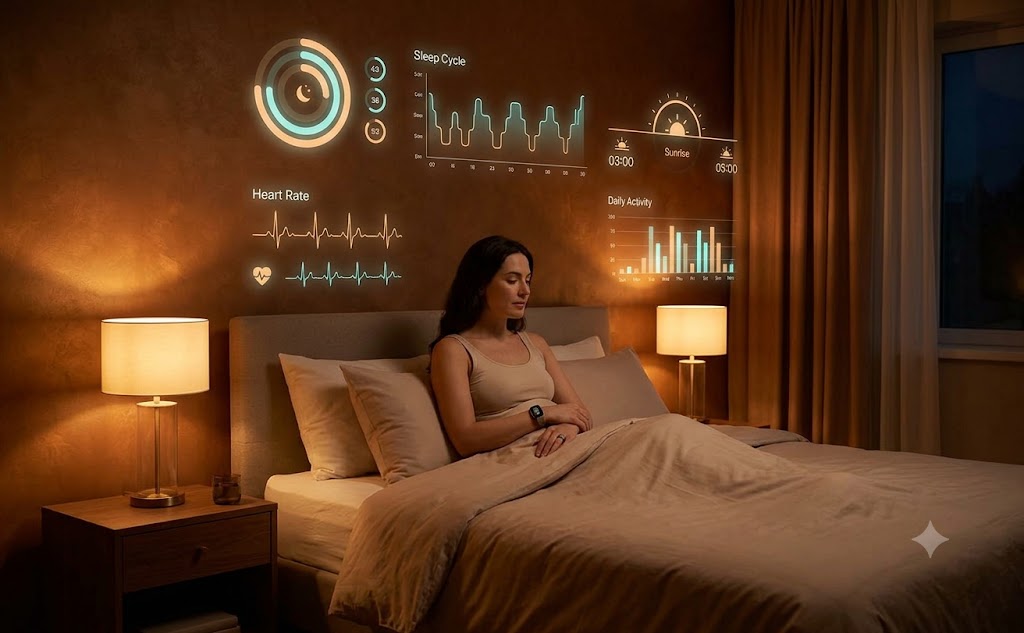
Understanding Your Sleep Data: What Wearables Actually Measure
The explosion of consumer sleep tracking has given millions of people access to data that was previously only available in sleep labs. But interpreting that data correctly requires understanding what wearables can and can’t measure.
What Wearables Measure Well:
- Total sleep time — reasonably accurate
- Sleep timing — when you fell asleep and woke up
- Heart rate and HRV during sleep — accurate on most modern devices
- Movement and restlessness — accurate
- Respiratory rate — accurate on devices like Oura Ring and WHOOP
- Blood oxygen (SpO2) — useful for screening for sleep apnea
What Wearables Measure Less Accurately:
- Sleep stage classification (light, deep, REM) — consumer devices use movement and heart rate to estimate sleep stages, but they’re significantly less accurate than clinical polysomnography (PSG). Take specific sleep stage percentages with a grain of salt.
- Sleep quality scores — proprietary algorithms that combine multiple metrics. Useful as a general trend indicator but not a precise clinical measurement.
The best way to use sleep wearable data: Focus on trends over time rather than single-night readings. If your deep sleep is consistently low, your recovery score is chronically poor, or your HRV is trending downward over weeks — that’s meaningful signal. One bad reading is noise.
The 10 Most Evidence-Based Sleep Optimization Strategies
1. Anchor Your Wake Time — Every Single Day
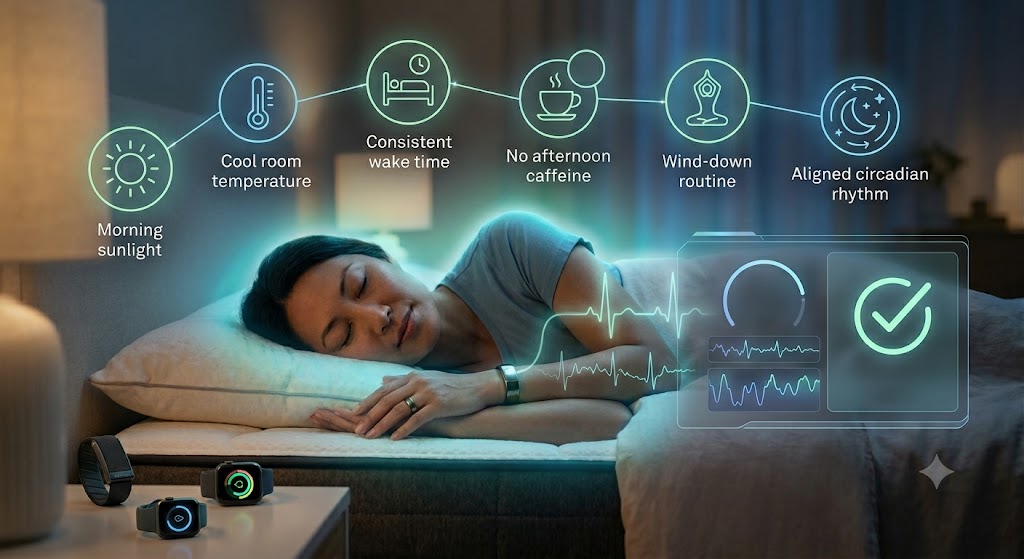
This is the single most impactful sleep optimization habit. Waking up at the same time every day — including weekends — anchors your circadian rhythm and builds consistent sleep pressure that makes falling asleep at your target bedtime dramatically easier.
Variable wake times (sleeping in on weekends, late nights during the week) create what researchers call “social jet lag” — circadian disruption that impairs sleep quality even when total hours are adequate.
2. Get Morning Sunlight Within 30 Minutes of Waking
10–15 minutes of natural outdoor light within the first 30 minutes of waking is one of the most powerful circadian anchors available. Morning light suppresses residual melatonin, triggers cortisol’s natural morning rise (which provides alertness and energy), and sets the circadian timer so that melatonin rises at the right time in the evening — approximately 14–16 hours after morning light exposure.
On cloudy days, you need more time outside (20–30 minutes) to get sufficient light intensity. Indoor lighting is rarely bright enough to adequately trigger this response.
3. Keep Your Bedroom Cold — Between 65–68°F (18–20°C)
Core body temperature needs to drop by 1–3°F to initiate and maintain sleep. A cool bedroom facilitates this drop. Most people sleep in rooms that are too warm — which reduces deep sleep quality and increases nighttime awakenings.
If you can’t control room temperature, cooling mattress pads (like Eight Sleep or ChiliPad) are among the highest-ROI sleep investments available for chronic sleep quality issues.
4. Eliminate Caffeine After 2 PM
Caffeine has a half-life of approximately 5–7 hours — meaning that a coffee at 3 PM still has 50% of its caffeine active in your system at 8–10 PM. Even if you can fall asleep easily after afternoon caffeine, research shows it reduces deep sleep by up to 20% — a reduction you likely won’t feel consciously but that significantly impairs overnight recovery.
5. Use Light Strategically in the Evening
In the 2 hours before bed, dim overhead lights, switch to warm-toned lighting (amber, red), and reduce screen brightness. Blue light from screens and bright overhead lighting suppresses melatonin production — the hormone that signals the brain it’s time to sleep.
This doesn’t mean you need to sit in darkness. Simply switching to lamps, using night mode on devices, or wearing blue-light-blocking glasses after sunset makes a meaningful difference in melatonin onset timing.
6. Create a Wind-Down Routine (30–60 Minutes)
The brain doesn’t switch instantly from alert to asleep. A consistent 30–60 minute wind-down routine before bed signals the nervous system that it’s safe to shift into sleep mode. Effective wind-down activities include:
- Light reading (physical book, not a tablet)
- Gentle stretching or yoga
- A warm shower or bath (the subsequent core temperature drop accelerates sleep onset)
- Journaling or writing tomorrow’s to-do list (offloads mental load)
- Meditation or breathwork
7. Reserve the Bed for Sleep and Sex Only
Stimulus control — the principle that your bed should be associated exclusively with sleep — is 1 of the most evidence-based components of CBT-I (cognitive behavioral therapy for insomnia). Working, scrolling, watching TV, or eating in bed trains the brain to associate the bed with wakefulness, making it harder to fall asleep when you actually want to.
8. Manage Alcohol Carefully
Alcohol is widely used as a sleep aid — but it’s actually a sleep disruptor. While alcohol can help you fall asleep faster, it fragments sleep architecture, suppresses REM sleep, and causes increased wakefulness in the second half of the night as it metabolizes. Even 1–2 drinks measurably reduces sleep quality on the night consumed.
If you drink, finish alcohol at least 3 hours before bed to minimize sleep disruption.
9. Exercise — But Time It Right
Regular exercise is one of the most powerful sleep quality enhancers available — increasing deep sleep, reducing sleep onset time, and improving overall sleep efficiency. However, vigorous exercise within 2–3 hours of bedtime can delay sleep onset by raising core body temperature and activating the sympathetic nervous system.
Morning and afternoon exercise produces the best sleep outcomes for most people. Gentle evening exercise (yoga, walking) is generally fine.
10. Screen for Sleep Apnea If You’re Not Feeling Rested
If you’re doing everything right — consistent schedule, dark and cool bedroom, no caffeine or alcohol close to bedtime — and still waking up exhausted, obstructive sleep apnea may be the culprit. Sleep apnea affects an estimated 1 billion people worldwide and is dramatically underdiagnosed.
Warning signs include: loud snoring, waking unrefreshed despite adequate hours, excessive daytime sleepiness, morning headaches, and — increasingly — low overnight SpO2 readings on wearable devices. If you suspect sleep apnea, getting a sleep study is a health priority, not an optional extra.
Frequently Asked Questions (FAQ)
Q: How many hours of sleep do I actually need? A: The evidence consistently points to 7–9 hours for most adults. Individual variation exists — some people genuinely function well on 6.5 hours, while others need 9. Your need is determined by genetics, age, activity level, and health status. The best indicator is how you feel without an alarm clock after several nights of free sleep.
Q: Is the Oura Ring or WHOOP better for sleep tracking? A: Both are excellent. Oura Ring is generally preferred for sleep-specific tracking and is slightly more accurate for HRV measurement. WHOOP provides more detailed recovery and strain data and is better for athletes optimizing performance. Apple Watch is a solid option for those already in the Apple ecosystem, though its sleep tracking is less sophisticated than the dedicated devices.
Q: Do sleep supplements like magnesium and melatonin actually work? A: Magnesium glycinate (200–400mg before bed) has good evidence for improving sleep quality — particularly for people who are deficient, which is common. Melatonin is most effective for circadian rhythm issues (jet lag, shift work, delayed sleep phase) rather than primary insomnia. Low doses (0.5–1mg) are more effective than the high doses (5–10mg) commonly sold.
Q: What’s the ideal sleep schedule for optimal health? A: The ideal schedule is the one that aligns with your natural chronotype (whether you’re a morning person or evening person) while allowing 7–9 hours of sleep with consistent timing. Research suggests sleeping between approximately 10 PM and 7 AM aligns well with most people’s natural circadian rhythms, but individual variation is significant.
Q: Can you catch up on lost sleep on weekends? A: Partially. While weekend recovery sleep can reduce some of the acute effects of sleep deprivation, it doesn’t fully restore cognitive function or reverse the metabolic and cardiovascular effects of chronic short sleep. More importantly, sleeping in significantly on weekends creates social jet lag that disrupts the following week’s sleep quality.
Q: How long does it take to see results from sleep optimization changes? A: Most people notice improvements in 1–2 weeks of consistent behavioral changes. Circadian rhythm anchoring typically takes 2–3 weeks to stabilize. Improvements in HRV and deep sleep percentage, as measured by wearables, typically become apparent within 3–4 weeks of consistent implementation.
The Bottom Line
Sleep optimization in 2026 is no longer a luxury for wellness enthusiasts — it’s a medical imperative backed by overwhelming scientific evidence. Poor sleep doesn’t just make you tired. It impairs your cognition, disrupts your metabolism, weakens your immune system, damages your heart, and shortens your life.
The good news: sleep quality is highly responsive to behavioral change. The 10 strategies above — particularly anchoring your wake time, getting morning sunlight, keeping your bedroom cool, and eliminating afternoon caffeine — produce measurable improvements in sleep quality for most people within weeks.
Your wearable can tell you how you’re sleeping. The science can tell you why it matters. But the changes that actually improve your sleep happen in your daily habits — in the light you expose yourself to, the temperature you sleep in, the time you stop drinking coffee, and the consistency with which you wake up each morning.
Start tonight. Your brain, your body, and your tomorrow-morning self will all thank you.