There’s a moment most of us hit — usually around week three of “getting healthier” — where the motivation is still there, but the follow-through starts slipping. Not because you don’t care anymore, but because the habit hasn’t found anything to hold onto yet. That’s often where the right wellness products for self-care actually earn their keep — not as a replacement for the habit, but as the thing that makes the habit easier to actually keep doing. A pillow that stops you from waking up with a stiff neck. A wrap that takes the edge off wrist pain so you can keep typing through the day without wincing. A scent that tells your brain “okay, we’re winding down now,” so you’re not lying in bed wide awake at 11:30pm wondering why you can’t sleep.
We put this list together from our own store, VitaNorth, because these are genuinely useful wellness products for self-care that we use and stand behind — not because they’re trending on someone’s “get ready with me” video. Each one ties back to something we’ve talked about before on this blog, so consider this the practical, “here’s the actual tool” companion to those articles. We’re not going to tell you any of these are life-changing on their own. But paired with the habits that actually do the heavy lifting — movement, decent sleep, stress management — they can make the difference between a routine that sticks and one that quietly falls apart by February.
For Better Sleep
Sleep is usually the first thing to suffer when life gets busy, and it’s also usually the last thing people actually troubleshoot. Most of us default to “just go to bed earlier,” which sounds right but rarely works if the actual problem is something else entirely — like what’s happening in the hour before you even get into bed.
1. Blue Light Blocking Glasses
We’ve written before about why screens in the evening quietly sabotage your sleep — even when you feel like you’re winding down with something relaxing like a show or a scroll through your phone. The blue wavelengths from screens suppress melatonin production, which is the exact hormone your body needs to start feeling drowsy. The truth is most of us aren’t giving up our phones before bed anytime soon, and that’s fine — we’re not here to lecture you about a digital detox you’re not going to do.
Blue light blocking glasses are the compromise: put them on an hour or two before bed, and your evening routine barely has to change at all. You can still watch your show. You still get to scroll. Your body just gets a better shot at winding down naturally instead of fighting against artificial light that’s telling it to stay alert.
Good for: anyone who scrolls, works, or watches TV right up until lights-out and struggles to fall asleep once the screen goes dark.
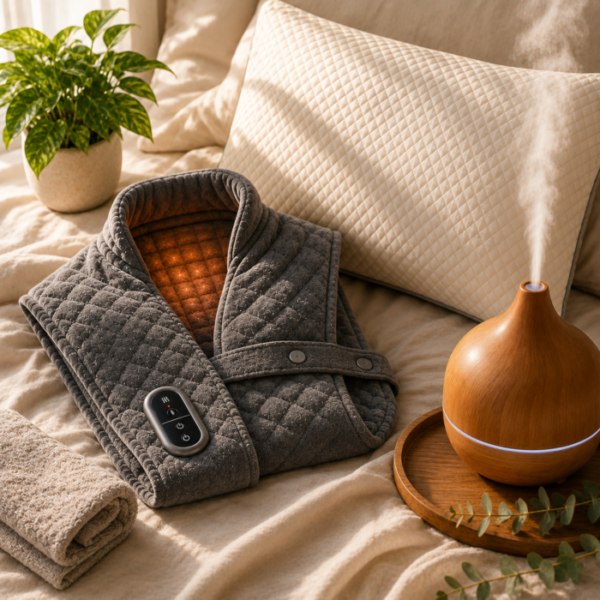
2. Wearable Heating Pad
Not every restless night is about screens — sometimes it’s just discomfort, whether it’s period cramps, lower back tension, or general soreness that flares up right as you’re trying to relax. There’s a specific kind of frustration in finally getting comfortable, only to have a dull ache pull you right back to being aware of your body again.
A wearable heating pad solves the annoying part of traditional heating pads: the part where they’re either plugged into the wall (so you can’t move) or awkwardly shaped so they slide off the second you shift positions. A wearable one lets you get warmth exactly where you need it, whether that’s your lower back, your abdomen, or your shoulders, without lying awkwardly still or worrying about it shifting once you actually fall asleep.
Good for: period pain, lower back discomfort, or general nighttime tension that makes it hard to settle in.
For Pain and Physical Recovery
If you spend your days sitting at a desk, standing on your feet, or doing repetitive movement of any kind, your body is absorbing more daily wear than you probably give it credit for. These next few products are about addressing that wear directly, rather than just pushing through it.
3. Lumbar Decompression Traction Belt
If your day involves a lot of sitting — and we’ve covered why that takes more of a toll than people expect — the lower back is usually the first place it shows up. Sitting for long stretches compresses the spine and shortens the hip flexors, and over time that combination is a recipe for chronic lower back tightness.
This inflatable belt is built to gently decompress the lower spine, essentially creating a small amount of traction that takes pressure off compressed discs. It’s not going to replace physical therapy if you’re dealing with a serious back condition, but for the everyday stiffness that builds up from a desk job, it can bring real, noticeable relief — especially worn for short periods after a long day of sitting.
Good for: desk workers and anyone managing chronic lower back tightness or mild disc-related discomfort.
4. Butterfly Memory Foam Pillow
We tend to blame neck and shoulder tension on stress or bad posture during the day, but sleep posture plays a bigger role than most people give it credit for. If your pillow doesn’t properly support the natural curve of your neck, you can spend seven or eight hours a night working against your own spine without realizing it.
This pillow is contoured specifically to support natural neck alignment, cradling the head and neck in a way that a standard flat pillow simply doesn’t. It’s a small change, but it’s the kind of thing you notice the first morning you wake up without that dull ache in your neck or shoulders that used to feel like just part of getting older.
Good for: side and back sleepers dealing with neck or shoulder discomfort, especially first thing in the morning.
5. Wrist Ice & Heat Therapy Wrap
Wrist strain has a way of sneaking up on people. It’s rarely one dramatic injury — it’s typing, scrolling, lifting, repetitive movement at work, and suddenly it’s just part of your day, something you’ve learned to work around instead of address.
This wrap alternates hot and cold therapy, which is one of the better-supported approaches for easing carpal tunnel-type discomfort without needing an appointment or a prescription. Cold therapy helps reduce inflammation in the acute moment, while heat therapy afterward helps relax the surrounding muscles and improve circulation to the area. Having both in one wrap means you’re not juggling an ice pack and a separate heating pad.
Good for: anyone doing repetitive hand or wrist work throughout the day, including typing, crafting, or manual labor.
6. Plantar Fasciitis Night Splint
If you’ve ever taken your first steps in the morning and felt that sharp, almost electric jolt in your heel, you already know how disruptive plantar fasciitis can be. It’s one of those conditions that’s genuinely difficult to just “push through,” since walking on it wrong tends to make it worse rather than better.
This splint keeps your foot in a gentle stretch overnight, holding the plantar fascia in a lengthened position instead of letting it tighten up while you sleep, which is what usually causes that painful first-step sensation. A randomized crossover study of chronic plantar fasciitis patients found that most patients who completed treatment with a dorsiflexion night splint reported improvement, making it one of the more evidence-backed at-home approaches for easing that first-step pain over time.
Good for: anyone dealing with heel pain, especially the kind that’s worse first thing in the morning.
For Movement and Fitness
We talk a lot on this blog about how movement doesn’t need to mean a full gym routine to actually count. Most days, a walk is enough. But there are also days you want something a little more targeted, and it’s worth having one simple option on hand for those.
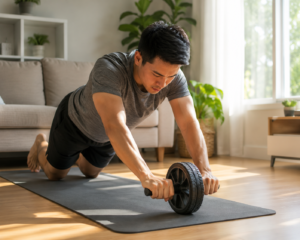
7. Automatic Rebound Ab Wheel Roller
A standard ab wheel is intimidating for a lot of people, and honestly, for good reason — it requires a decent amount of core strength and control just to use safely, which makes it a discouraging starting point for beginners. The automatic rebound feature on this version solves that problem directly: it assists the return motion, so you’re not straining to pull yourself back up and risking your lower back in the process.
It’s compact enough to use at home in the time it takes to boil water for tea, which matters more than it sounds like it should. The products that actually get used consistently tend to be the ones with the lowest barrier to starting, not the ones that require setting aside a dedicated block of time.
Good for: anyone wanting a quick, low-equipment core workout at home, especially if a standard ab wheel has felt too advanced.
For Stress and Nervous System Support
Managing stress isn’t just about eliminating stressors — for most of us, that’s not realistic. It’s more about building small, repeatable cues that help your nervous system shift out of “on” mode, even for a few minutes a day.
8. Aromatherapy Essential Oil Diffuser
We’ve mentioned before how small sensory rituals help cue your nervous system to actually downshift, rather than just hoping you’ll relax on command the moment you decide it’s time to. Scent is one of the most direct sensory pathways to the brain’s emotional centers, which is part of why certain smells can instantly shift your mood.
A diffuser paired with a consistent scent and a set time each evening becomes part of the wind-down itself. Over time, your brain starts to associate that specific smell with “we’re done for the day,” almost like a Pavlovian cue for relaxation. It’s a small, low-effort addition, but consistency is what makes it work — the same scent, roughly the same time, most nights.
Good for: anyone building an evening routine or a meditation practice and wanting a sensory anchor for it.
9. Handmade Sound Healing Singing Bowl
Same idea, different sense. A singing bowl gives you something physical and grounding to open or close a session with, rather than just sitting down and hoping your mind quiets on its own. There’s something about the sound fading out slowly that naturally draws your breathing down with it, even if you’re not consciously trying to slow your breath.
For people newer to meditation, having a clear physical action — striking the bowl, listening to it ring out — can make the practice feel less abstract and more like something you’re actually doing, rather than just sitting and waiting for calm to arrive.
Good for: meditation beginners who want their practice to feel more intentional and less rushed or vague.
For Everyday Self-Care
10. 3-in-1 Neck & Face Thermal Massager
This one’s less about fixing a specific problem and more about protecting a few minutes that are just for you, which matters more than it might sound like on paper. It combines gentle heat with massage for the neck and face, the kind of five-minute ritual that’s easy to slot in after a long day without requiring any real planning or setup.
It doubles as a bit of skin care too, since the warmth and massage can help with circulation in the face, but the bigger value for most people is simply having a built-in excuse to sit still and do nothing else for a few minutes. In a day full of tasks, that’s not nothing.
Good for: anyone who wants a low-effort way to unwind at the end of the day, without it feeling like one more thing on the to-do list.
Frequently Asked Questions
Do I need to buy all of these products, or can I just start with one?
Just one. Actually, we’d recommend starting with whichever one matches whatever’s bothering you most right now — sleep, a specific ache, or stress — rather than trying to overhaul your whole routine at once. These work best added one at a time, so you can actually tell what’s helping.
Are these products a replacement for seeing a doctor or physical therapist?
No. They’re meant to support everyday comfort and self-care, not replace professional care. If you’re dealing with persistent or severe pain, a specific diagnosed condition, or anything that isn’t improving, it’s worth talking to a healthcare provider rather than relying on a product alone.
Why do you sell these products yourself instead of just recommending random ones you found online?
Honestly, it’s the opposite direction — we started VitaNorth because we kept looking for products like these ourselves and wanted a curated place to find them. We only include products in this list that we’d genuinely recommend to a friend, whether or not they came from our own store.
Which of these is best for someone just starting to build a self-care routine?
The blue light blocking glasses or the aromatherapy diffuser tend to be the easiest entry points — low effort, no learning curve, and you’ll notice a difference within the first week or two.
Will these products work for everyone?
Not necessarily, and we wouldn’t claim otherwise. Bodies respond differently, and something that works well for one person’s back pain might do nothing for someone else’s. That’s part of why we’d suggest starting with one item tied to your most immediate need, rather than buying several at once.
A Quick Note Before You Shop
None of these are magic fixes — we’d never say that. They’re wellness products for self-care that work best alongside the habits we talk about across this whole blog: movement, decent sleep, managing stress, and actually listening to what your body’s telling you.
If you’re dealing with a specific health condition, it’s always worth running anything new by your healthcare provider first, especially anything involving pain management, before adding it into your routine.
You can browse the full collection at VitaNorth if any of these caught your eye.
Disclaimer: This article recommends products sold by VitaNorth, a business we personally operate. We only recommend what we genuinely believe helps, and this article is for general informational purposes — it isn’t medical advice.