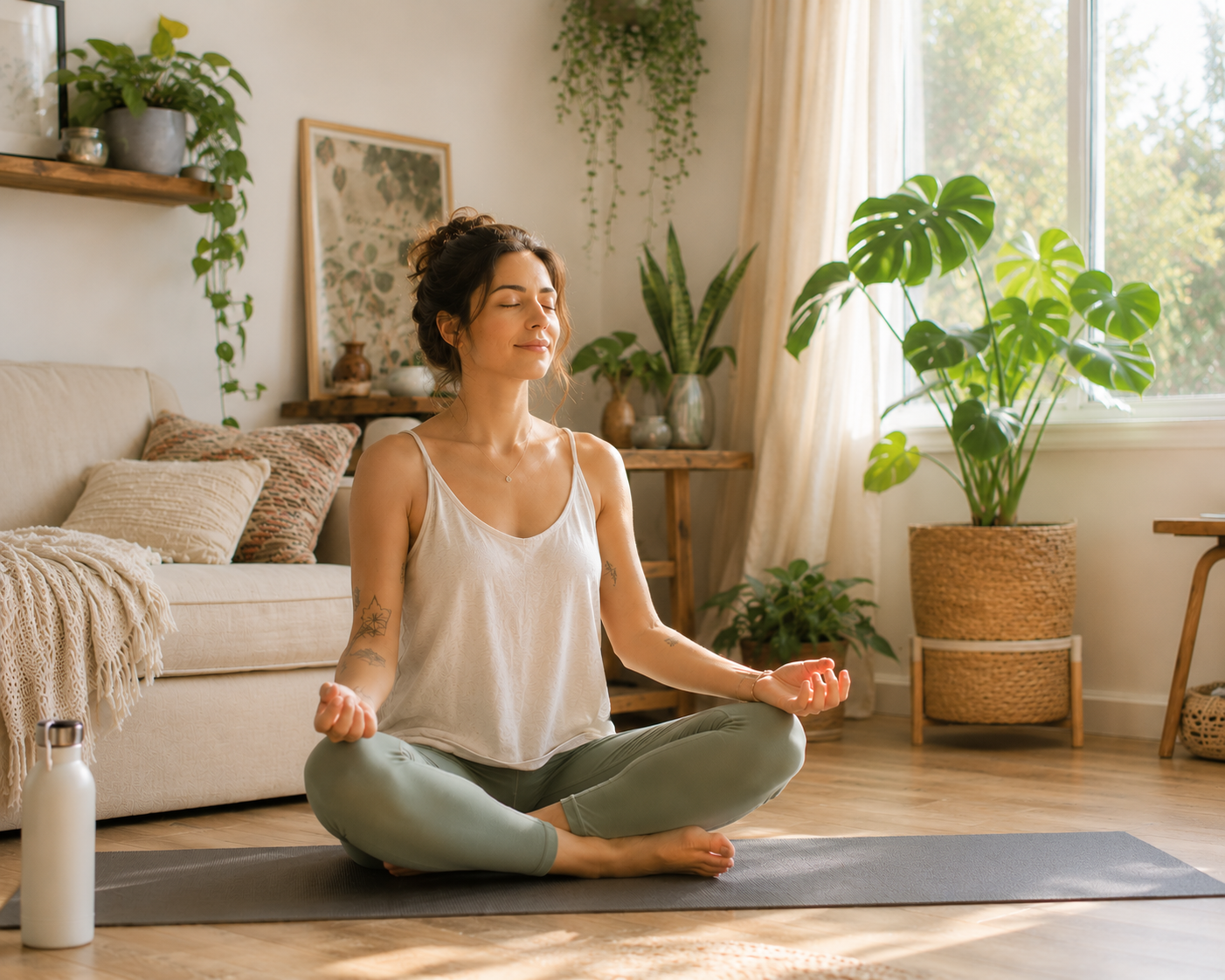

If you’ve been waking up tired, carrying tension in your shoulders for months, or feeling like your body just won’t fully relax no matter what you try — you’re not imagining it. The stress isn’t just in your head. It’s in your body too.
That’s exactly what somatic exercises for beginners are designed to address. And in 2026, more people than ever are discovering this gentle, science-backed practice as a way to finally feel at ease in their own skin.
This isn’t another intense workout trend. There are no reps to count, no gym membership required, and no equipment to buy. Somatic exercises work by reconnecting your mind to your body — helping your nervous system recognize that the danger has passed, and that it’s safe to let go.
Let’s break down exactly what somatic exercises are, why they work, and 5 beginner-friendly moves you can start doing at home today.
I. What Are Somatic Exercises, Exactly?
The word “somatic” comes from the Greek word soma, which simply means “body.” Somatic exercises are slow, intentional movements that focus on how your body feels from the inside — not how it looks from the outside.
Unlike a regular workout where you’re pushing through reps and chasing a burn, somatic exercises ask you to slow down and pay attention to what’s happening in your body as you move. The goal isn’t performance. It’s awareness.
These practices were originally developed in the 20th century and have been used in therapy, dance, and physical rehabilitation. But in recent years, somatic healing has made a major jump into everyday wellness — and for good reason. Research has shown that the body physically holds onto stress, anxiety, and even trauma in the form of chronic muscle tension, shallow breathing, and nervous system dysregulation.
Somatic exercises help undo that. They work from the body upward — called a “bottom-up” approach — rather than trying to think or talk your way through stress.
II. Why Stress Gets Stuck in Your Body (And Why It Matters)

Here’s something a lot of people don’t realize: your nervous system doesn’t automatically know when stress is over.
When you experience something overwhelming — a difficult conversation, a near-miss in traffic, a period of burnout, or even years of low-grade daily stress — your body activates a survival response. Your heart rate jumps, your muscles tighten, your breath shortens, and your system braces for impact.
The problem is, in modern life, the stressor is rarely a one-time event. It’s ongoing. Deadlines, financial pressure, health worries, difficult relationships — the nervous system stays in that alert state without ever fully powering down.
Over time, that unresolved tension gets stored in the body as chronic tightness, fatigue, anxiety, digestive issues, and disrupted sleep. This is why some people feel exhausted even after a full night’s rest, or why their shoulders are perpetually knotted no matter how many massages they get.
This is also closely tied to cortisol — the body’s primary stress hormone. If you’ve been reading about cortisol and belly fat, you already know how a constantly activated stress response can affect your weight, your energy, and your health in ways that go far beyond just feeling tense.
Somatic exercises interrupt that cycle. They send safety signals directly to the nervous system through movement, breath, and sensation — helping your body finally complete the stress response and come back to balance.
III. The Science Behind Somatic Healing
You don’t have to take this on faith. There’s real research behind why somatic practices work.
The nervous system has 2 main states: the sympathetic state (fight-or-flight) and the parasympathetic state (rest-and-digest). Most people with chronic stress spend way too much time in sympathetic mode — always alert, always bracing — and struggle to shift into parasympathetic mode where real healing happens.
Somatic exercises activate the parasympathetic nervous system by engaging slow movement, diaphragmatic breathing, and interoception (the internal sense of what’s happening in your body). When you move slowly and pay attention to how it feels, you essentially give your nervous system a clear signal: we’re safe now.
This is the same principle behind improving vagus nerve tone — the vagus nerve is the main highway of your parasympathetic nervous system, running from your brain to nearly every major organ. If you’ve read our piece on how to improve vagus nerve tone naturally, you’ll recognize that somatic exercises are one of the most powerful tools for supporting that system.
Studies have also shown that slow, body-focused movement can reduce markers of inflammation, lower resting cortisol levels, improve sleep quality, and reduce symptoms of anxiety and depression. These aren’t just “feel good” effects — they’re measurable physiological changes.
IV. Who Benefits Most From Somatic Exercises?
Somatic exercises for beginners aren’t just for people dealing with trauma. They’re genuinely useful for anyone who:
- Carries chronic tension in their neck, shoulders, jaw, or hips
- Struggles to fall asleep or stay asleep (tip: combining this with what you learned in our magnesium glycinate for sleep guide can be especially effective)
- Feels emotionally “on edge” or easily overwhelmed
- Has been dealing with burnout or long-term work stress
- Experiences anxiety that seems to live in the body — tight chest, shallow breath, clenched jaw
- Is recovering from a period of illness, injury, or major life change
- Simply wants a gentle, sustainable way to wind down daily
You don’t need a diagnosis or a difficult past to benefit. If you have a human nervous system and you live in the modern world, somatic work has something to offer you.
V. 5 Beginner-Friendly Somatic Exercises to Try at Home
These 5 exercises are gentle, effective, and require nothing but a quiet space and a few minutes. Go slowly. Pay attention to what you feel. There’s no wrong way to do this — the awareness itself is the practice.
1. The Body Scan (3 to 5 Minutes)
This is the foundation of somatic practice. Lie down on your back with your arms at your sides. Close your eyes. Starting at the top of your head, slowly move your attention downward through each part of your body — forehead, jaw, throat, shoulders, chest, belly, hips, legs, feet.
At each area, simply notice. Is there tension? Warmth? Numbness? Don’t try to fix or change anything. Just observe. Most people are surprised how much sensation they’ve been completely tuned out from.
Do this for 3 to 5 minutes every day. Over time, you’ll start noticing tension earlier — before it builds into pain or exhaustion.
2. Grounding Breath (5 Minutes)
Sit in a chair with both feet flat on the floor. Place 1 hand on your chest and 1 hand on your belly. Breathe in slowly through your nose for a count of 4, letting your belly rise first, then your chest. Hold for 2 counts. Exhale slowly through your mouth for a count of 6.
The extended exhale is the key. A longer exhale activates the vagus nerve directly, triggering your parasympathetic (rest-and-restore) response within minutes. Repeat this 8 to 10 times.
This is one of the fastest ways to shift out of a stress response — and you can do it anywhere.
3. Neck and Shoulder Release (5 to 7 Minutes)
Sit or stand comfortably. Very slowly, drop your right ear toward your right shoulder — not forcing it, just letting gravity do the work. Hold for 20 to 30 seconds and breathe. Notice where you feel the stretch. Then slowly return to center and repeat on the left side.
Next, gently roll your shoulders backward in slow circles — 5 circles back, then 5 circles forward. Move like you’re wading through warm water, not cranking through a stretch.
Most people hold enormous amounts of tension in the neck and shoulders — often the first place the body stores stress. This gentle release, done slowly and with awareness, signals the nervous system to start letting go.
4. Hip Pendulum (5 Minutes)
Lie on your back with your knees bent and feet flat on the floor. Slowly let both knees drop to the right as far as is comfortable. Hold for a few breaths. Notice the sensation in your hips and lower back. Then slowly bring your knees back to center, and let them drop to the left.
The hips are considered one of the primary areas where the body stores unresolved stress and emotion — it’s not just a yoga cliché, there’s actual anatomical logic to it. The psoas muscle, which runs through your hip area, is directly connected to your fight-or-flight response. Gentle hip movement like this one helps release long-held tension from that area.
Do this slowly for 5 minutes, alternating sides. Let your breath lead each movement.
5. Shaking and Tremoring (3 to 5 Minutes)
This one sounds strange, but it’s one of the most effective somatic tools available. Stand with your feet shoulder-width apart. Slightly bend your knees. Begin bouncing gently — heels just barely coming off the ground — so your whole body vibrates softly.
After about 30 seconds, stop bouncing and just stand still. Notice the sensations: warmth, tingling, subtle movement. Then begin again.
Animals in the wild naturally shake after a stressful encounter — it’s how they discharge the energy of the fight-or-flight response and return to calm. Humans have largely lost this reflex, but we can intentionally reintroduce it. This type of tremoring is a core tool in many somatic therapy modalities and is remarkably effective at releasing deep-held physical tension.
VI. How Often Should You Practice?
Consistency matters more than duration here. Even 10 minutes of somatic practice every day will create more change than an hour-long session once a week.
A simple starting routine:
- Morning: 3 to 5 minutes of grounding breath before you get out of bed
- Midday: Body scan or neck/shoulder release at your desk
- Evening: Hip pendulum or tremoring to wind down before sleep
Give yourself 2 to 3 weeks before judging results. The nervous system changes slowly — but the changes are real and lasting.
VII. What to Expect in the First Few Weeks
In the first few days, you might notice more sensation than usual — not because something is wrong, but because you’re paying attention in a way you haven’t been. Tension that was background noise suddenly becomes noticeable.
By week 2, most beginners report sleeping slightly better, feeling a bit less reactive, and having more moments throughout the day where their body feels genuinely at ease.
By week 3 to 4, the shift becomes more consistent. Less background anxiety. Lighter shoulders. A clearer head. Better digestion. More restful sleep.
These benefits compound over time. The longer you practice, the more quickly your nervous system can return to calm when stress does arise — because it’s been trained to do so.
VIII. A Word on When to Seek Professional Support
Somatic exercises are safe for most people and can be done completely independently. However, if you’re working through significant trauma, or if self-practice triggers intense emotional responses (panic, dissociation, or a sense of shutdown), it’s worth working with a trained somatic therapist who can guide the process at a pace that’s right for you.
For everyday stress, burnout, chronic tension, and anxiety, these at-home exercises are a genuinely effective starting point — and for many people, they’re all that’s needed.
The Bottom Line
Somatic exercises for beginners are one of the most accessible and underrated wellness tools available right now. They don’t require equipment, a gym, or a lot of time. They just require you to slow down and listen to what your body has been trying to tell you.
Your nervous system wants to return to calm. Somatic practice is how you help it get there.
Start with just 10 minutes tomorrow morning — a body scan, some grounding breath, a slow neck release. Notice what shifts. Your body has been waiting for exactly this kind of attention.
“If you want more practical tools for stress and emotional wellbeing, our relationship advice books guide covers boundary setting and emotional patterns too.”
Looking to support your recovery and relaxation even further? Explore how red light therapy at home can complement your somatic practice — and check out our guide on improving vagus nerve tone naturally for a deeper dive into nervous system health.