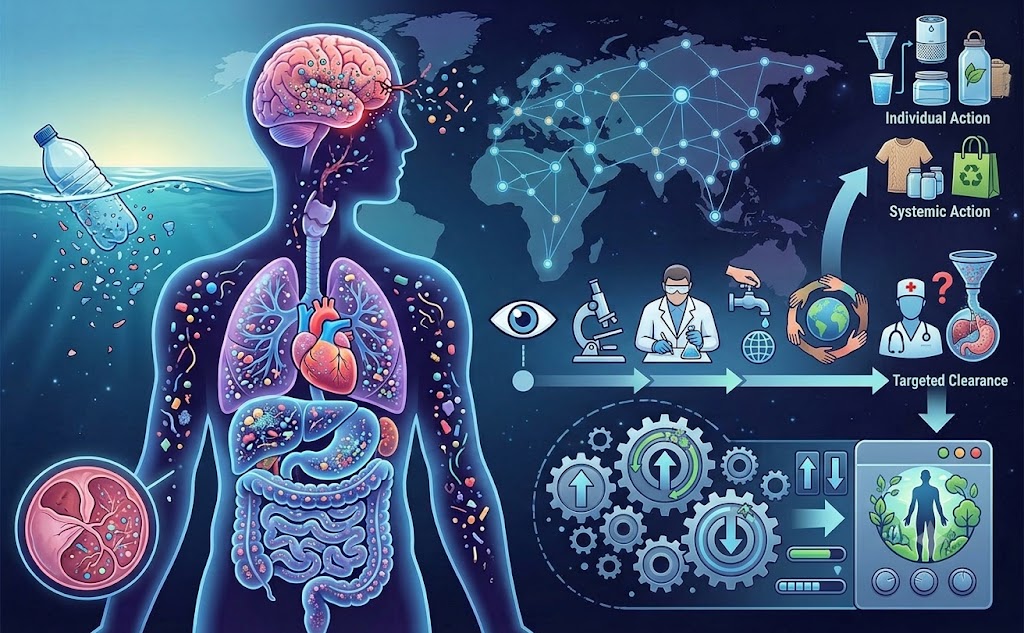
Tackling microplastics human health concerns has finally moved from the margins of environmental science to the center of global public health conversation — and 2026 is the year the response is shifting from awareness to action.
For years, the microplastic conversation was framed primarily as an environmental issue — plastic in the ocean, harm to marine life, pollution of ecosystems. Important, absolutely. But what changed the conversation — fundamentally and irreversibly — was the accumulating evidence that microplastics aren’t just in the environment.
They’re in us.
In our blood. In our lungs. In our placentas. In our breast milk. And now, confirmed by landmark 2024 research, in our brain tissue — in concentrations 7–30 times higher in people with dementia than in neurologically healthy individuals.
The wellness and public health sectors are responding — with a range of interventions from individual-level exposure reduction strategies to systemic policy advocacy to emerging clinical protocols claiming to reduce microplastic load in the body. Here’s where things stand in 2026 — and what you need to know.
The Scale of the Problem: Why 2026 Is a Turning Point
To understand why 2026 feels like a turning point in the microplastic conversation, it helps to understand how rapidly scientific understanding has accelerated.
Just 5 years ago:
- Microplastics had been detected in the environment and in some human tissue samples
- The blood-brain barrier was thought to be a reliable barrier against microplastic entry to the brain
- Microplastics were primarily discussed as an environmental concern
- No mainstream medical organization had issued specific health guidance on microplastic exposure
In 2026:
- Microplastics have been confirmed in virtually every human tissue and fluid tested
- Nanoplastics are confirmed to cross the blood-brain barrier
- Human brain microplastic concentrations are measurably higher in dementia patients
- The World Health Organization has elevated microplastics to a priority health concern
- Multiple governments have implemented or are implementing plastic reduction regulations
- Private clinics are offering (controversial) microplastic “detox” protocols
- Major research funding has been directed toward understanding health mechanisms and interventions
- Consumer awareness has reached a tipping point — microplastics are now a mainstream health conversation
This is what a public health crisis transitioning from denial to action looks like.
What the Public Health Sector Is Doing

Government Regulatory Action
Multiple governments have accelerated plastic reduction regulations in response to the health evidence:
The European Union has implemented some of the world’s most aggressive microplastic regulations — including restrictions on intentionally added microplastics in cosmetics, detergents, and agricultural products, with projected reduction of 36,000 tonnes of microplastic releases per year.
The United States passed the Save Our Seas Act and has expanded FDA oversight of food contact plastics, though critics argue federal action remains insufficient relative to the scale of the problem.
Several Asian countries — including South Korea and Japan — have implemented comprehensive single-use plastic reduction frameworks with measurable impacts on environmental plastic load.
The regulatory trend is clear: plastic restrictions are becoming more comprehensive globally. But the timeline between regulatory action and meaningful reduction in human body burden is measured in decades — meaning the microplastics already in circulation will continue accumulating in human bodies regardless of what we do about new plastic production.
Medical Research Initiatives
Research funding directed at microplastics has increased dramatically:
- The NIH allocated significant new funding in 2024–2026 to microplastic health research — covering mechanisms of toxicity, exposure assessment, and intervention development
- The European Research Council has funded multiple large-scale human cohort studies examining microplastic exposure and health outcomes
- Academic medical centers including Harvard, Stanford, and Johns Hopkins have established dedicated microplastics research programs
The critical research questions being pursued:
- Causation vs. correlation: Do microplastics cause the neurological and cardiovascular diseases they’re associated with, or do they simply accumulate in already-diseased tissue?
- Dose-response: What exposure levels are harmful, and is there a safe threshold?
- Vulnerable populations: Are children, pregnant women, and people with existing health conditions at disproportionate risk?
- Clearance mechanisms: Can the body eliminate microplastics more effectively with specific interventions?
Public Health Communication
Health organizations including the WHO, CDC, and multiple national health agencies are developing consumer guidance on microplastic exposure reduction — a significant evolution from the position of “not enough evidence to make recommendations” that was standard just 3 years ago.
What the Wellness Sector Is Doing — And What’s Controversial
The wellness industry — never one to wait for regulatory consensus — has moved aggressively into the microplastics space, with a range of products and protocols claiming to reduce microplastic burden in the body.
Evidence-Based Wellness Responses
Water filtration: The recommendation to switch from bottled water to reverse-osmosis filtered tap water is strongly evidence-based. Bottled water contains dramatically more microplastics than filtered tap water, and the switch is straightforward and affordable.
Dietary modification: Reducing consumption of foods with high microplastic contamination — seafood (particularly shellfish), canned foods, salt — has a logical evidence base and aligns with broader healthy eating recommendations.
Air filtration: HEPA air purifiers reduce airborne microplastic fiber exposure in indoor environments. The evidence base for indoor air quality improvement is solid.
Lifestyle packaging changes: Replacing plastic food containers with glass, ceramic, and stainless steel — and never heating food in plastic — reduces direct microplastic ingestion from food contact materials.
Controversial Wellness Responses
“Microplastic detox” protocols: A growing number of private clinics — particularly in the longevity and functional medicine space — are offering protocols claiming to accelerate the body’s elimination of microplastics. These typically include combinations of:
- Specific dietary approaches (high-fiber, antioxidant-rich diets)
- Sauna therapy (proposed to facilitate excretion through sweat)
- Chelation-adjacent protocols
- Targeted supplement regimens (glutathione, NAC, activated charcoal)
The honest assessment: There is currently no clinical evidence that any protocol accelerates microplastic elimination from the body in a clinically meaningful way. The body does excrete microplastics — primarily through feces — and some compounds may support this process, but quantified, validated “detox” protocols don’t yet exist.
This doesn’t mean these approaches are harmful — many of the underlying recommendations (high fiber diet, sauna, antioxidant-rich nutrition) have independent health benefits. But marketing them specifically as microplastic detox protocols ahead of the evidence is premature.
Supplement marketing: The microplastic conversation has generated significant supplement industry activity, with products claiming to “bind,” “eliminate,” or “protect against” microplastics. Most of these claims have minimal or no clinical substantiation. Activated charcoal, zeolites, and similar binding agents may trap some microplastics in the gut before absorption, but evidence for meaningful human health benefit is lacking.
The Most Effective Exposure Reduction Strategies — 2026 Evidence Review
Based on the current evidence, here’s the most accurate ranking of microplastic exposure reduction strategies by impact:
Highest impact:
- Switch to filtered tap water (reverse osmosis) — eliminates 1 of the largest sources of microplastic ingestion
- Never heat food in plastic — prevents a major route of direct ingestion
- Replace plastic food storage with glass/stainless steel — reduces ongoing daily ingestion
- Install HEPA air filtration in home — reduces inhalation exposure
Moderate impact: 5. Replace plastic cutting boards with wood/bamboo — reduces microplastics in food from meal prep 6. Use a microplastic-catching laundry bag for synthetic clothes — reduces indoor air and water contamination 7. Choose natural fiber clothing and textiles — reduces ambient microfiber load in living spaces 8. Reduce seafood and canned food consumption — reduces dietary microplastic intake
Lower impact (but meaningful over time): 9. Carry a glass or stainless steel water bottle — replaces disposable plastic bottles 10. Choose loose-leaf tea over plastic tea bags — many tea bags contain plastic that leaches during steeping 11. Reduce single-use plastic food packaging — buying whole foods with minimal packaging reduces indirect exposure
What’s Coming Next: The Future of Microplastics and Human Health
Several developments in the next 3–5 years are likely to significantly advance both understanding and response:
Definitive causation studies: Large human cohort studies currently underway will provide clearer answers on whether microplastic exposure causes neurological and cardiovascular disease — or is primarily a marker of other environmental exposures.
Biomarker development: Validated blood or urine tests for microplastic body burden are in development. Once available, these will enable both population-level exposure assessment and individual monitoring in response to exposure reduction interventions.
Targeted pharmacological interventions: Research into compounds that might facilitate microplastic excretion or neutralize their inflammatory effects is early-stage but active.
Biodegradable plastic alternatives: The plastics industry is accelerating development of genuinely biodegradable materials — though “biodegradable” marketing claims require careful scrutiny, as many current “biodegradable” plastics still produce microplastic fragments during degradation.
Global treaty framework: International negotiations on a Global Plastics Treaty are ongoing. If successful, this could establish the first international legally binding framework for plastic production reduction — the most upstream intervention available.
Frequently Asked Questions (FAQ)
Q: Can you detox from microplastics? A: The body naturally excretes some microplastics — primarily through feces. No clinically validated “detox” protocol for accelerating microplastic elimination from the body currently exists. The most evidence-based approach is to reduce ongoing exposure while supporting general health and elimination through adequate fiber intake, hydration, and avoiding additional toxic exposures.
Q: How long do microplastics stay in the body? A: This varies significantly by particle size and type. Larger microplastic particles (those that don’t cross tissue barriers) are typically excreted within days to weeks through the digestive system. Nanoplastics that cross tissue barriers and accumulate in organs may persist for months to years. The residence time in brain tissue is particularly uncertain.
Q: Are some people more at risk from microplastics than others? A: Yes. Children (more permeable barriers, developing systems), pregnant women (risk of placental transfer), people with existing inflammatory or neurological conditions, and high-exposure occupational groups (workers in plastic manufacturing, fishing, recycling) appear to face disproportionate risk.
Q: Does eating organic food reduce microplastic exposure? A: Partially. Organic farming practices reduce some synthetic chemical exposures. However, microplastic contamination is so pervasive — in soil, water, and air — that organic certification does not guarantee low microplastic content in food. The packaging that organic food comes in may itself be a microplastic source.
Q: Is the microplastics problem getting better or worse? A: Currently worse — global plastic production continues to increase, and microplastic concentrations in the environment and human body are rising. Regulatory responses are beginning to slow production growth in some regions, but the microplastics already in circulation will continue to fragment and spread for decades.
Q: What’s the most important thing I can do about microplastics today? A: Switch your primary drinking water source to reverse osmosis filtered tap water. This addresses 1 of the largest and most modifiable daily exposure sources and makes an immediate, meaningful difference in your daily microplastic ingestion.
The Bottom Line
Tackling microplastics as a human health issue in 2026 means confronting 1 of the most pervasive and complex environmental health challenges ever faced — a pollutant that is simultaneously everywhere in the environment and inside virtually every human body on earth.
The public health and scientific response is accelerating. Regulatory action is expanding. Research funding is increasing. And consumer awareness has finally reached the scale needed to drive meaningful market and policy change.
But the honest reality is this: the microplastics already in human bodies — including in brain tissue — are not going away quickly. The priority now is stopping more from getting in while science works to understand and address what’s already there.
The exposure reduction strategies outlined here and in our companion article are your most effective tools available today. They won’t eliminate the problem — nothing can right now — but they can meaningfully reduce your ongoing exposure and the long-term accumulation that the research increasingly suggests poses real neurological and systemic health risk.
The wellness industry has moved. The public health sector is moving. The science is moving.
Now it’s your turn.