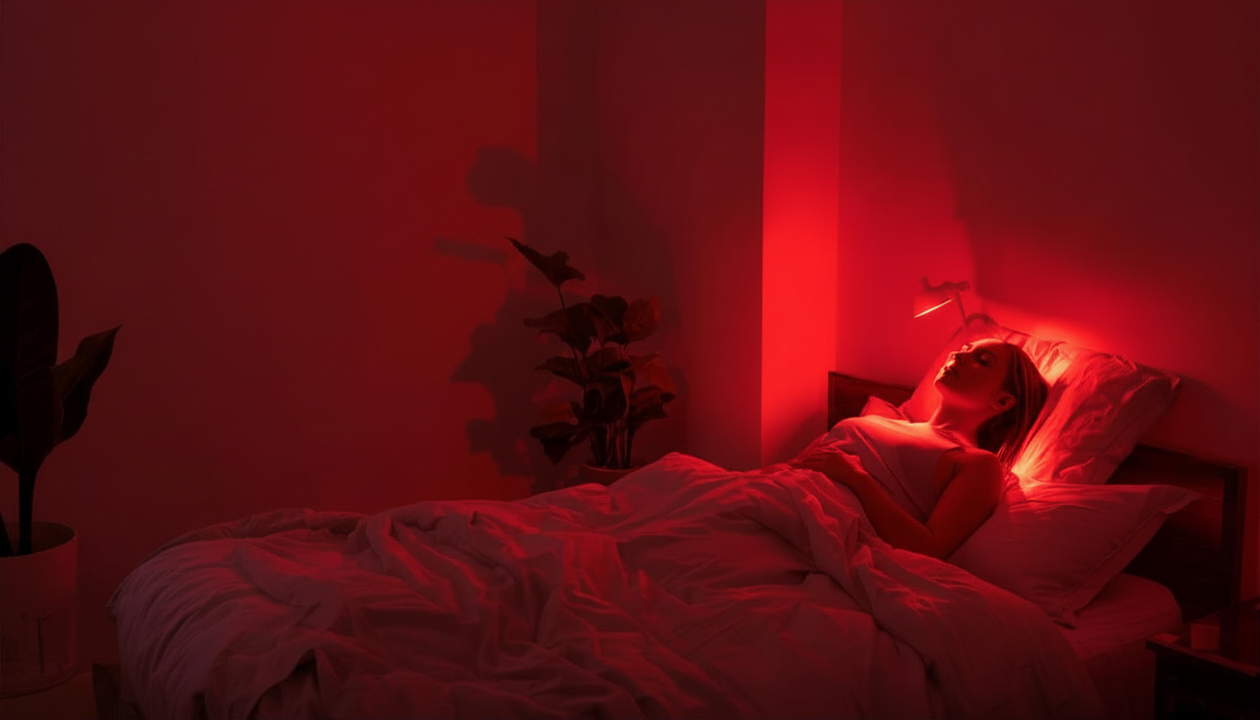
Red light therapy benefits at home are no longer a fringe wellness claim — they’re backed by a growing body of peer-reviewed research, FDA clearance for multiple device types, and a 2025 expert consensus review signed off on by more than 20 specialists in dermatology, sports medicine, and neurology. The technology has moved from clinical settings into living rooms fast, and with that speed has come both legitimate science and considerable marketing noise.
This guide cuts through both. Here’s what red light therapy actually does, what the evidence genuinely supports, and how to think about home devices if you’re considering one.
I. What Is Red Light Therapy?
Red light therapy — also called photobiomodulation or low-level light therapy (LLLT) — works by exposing the skin to specific wavelengths of red and near-infrared light. The visible red range covers approximately 600 to 700 nanometers. Near-infrared light, which the naked eye can’t see, falls between roughly 750 and 1,100 nanometers and penetrates more deeply into tissue.
The foundational mechanism centers on the mitochondria — the energy-producing structures inside your cells. Chromophores in the mitochondria, particularly an enzyme called cytochrome c oxidase, absorb specific wavelengths of red and near-infrared light. When they do, the mitochondria are stimulated to produce more adenosine triphosphate (ATP), which is essentially cellular energy currency. More ATP means cells can do their jobs more efficiently, repair damage faster, and handle inflammation more effectively.
This cellular-level energy boost is why the effects of red light therapy ripple across so many different tissues and applications — it’s not targeting a specific receptor, it’s stimulating a fundamental cellular process.
The history is worth knowing. Hungarian scientists in the 1960s accidentally discovered that low-level red light stimulated hair growth in rodents. Interest accelerated in the 1990s when NASA researchers growing plants under LED lights in space noticed that small cuts on their hands healed unusually quickly under those same lights. Those early observations launched the field of research that continues expanding today.
II. What the Research Actually Supports
A 2025 expert consensus review — involving more than 20 specialists across multiple fields — assessed the current state of evidence for photobiomodulation. Here’s what it found credible enough to recommend:
i. Pattern hair loss (androgenetic alopecia). This is one of the most robust applications. Multiple trials have found that red and near-infrared light stimulates hair follicles and promotes hair growth. The FDA has cleared several at-home devices — including caps, helmets, and combs — specifically for hair regrowth.
ii. Wound healing and peripheral neuropathy. The research on accelerated tissue repair is strong. Red light therapy has been found to reduce healing time for various types of ulcers and wounds, and to help with peripheral neuropathy — nerve damage that causes pain, numbness, or tingling, often in the hands or feet.
iii. Oral mucositis. Red light therapy is now part of clinical guidelines for preventing and treating the painful mouth sores that commonly accompany chemotherapy and radiation treatment. This is a clinical recommendation, not a wellness claim.
iv. Skin texture and signs of aging. A study measuring the effects of a red light therapy mask found improvement in skin quality and reversal of visible aging signs after 3 months of use, with results lasting up to a month after stopping. A 2025 study specifically on at-home red light devices showed improvement in acne in participants who used them consistently. A separate study on at-home masks showed a reduction in crow’s feet depth and an increase in skin thickness.
v. Pain management and muscle recovery. There’s meaningful evidence suggesting that red light therapy can reduce joint pain, ease muscle soreness after exercise, and accelerate recovery. Sports medicine has taken particular interest in this application, and many professional athletic facilities now include full-body red light panels in their recovery protocols.
One important caveat: much of the research uses clinical-grade devices that are significantly more powerful than most consumer home products. The principle is the same, but the trade-off is power. Home devices work — the FDA has cleared several of them — but they typically require longer and more consistent use to achieve results comparable to in-office treatments.
III. What Red Light Therapy Doesn’t Do (or Hasn’t Proven Yet)
This matters as much as what it does. Some claims circulating in the market aren’t well-supported:
- Lymphatic drainage — mentioned on many product pages, but not clearly demonstrated in controlled studies
- “Detoxification” — a physiologically meaningless term; the liver and kidneys handle detoxification, and light doesn’t meaningfully change that
- Weight loss or fat burning — claims exist, but the evidence is weak and inconsistent
- ADHD and major brain conditions — some early research is intriguing, but far too preliminary to make confident claims
A pattern worth noting: red and near-infrared light tends to have stronger effects on cells that are already under stress or metabolic dysfunction than on healthy, normally functioning cells. This may explain why results vary significantly between individuals — people with more cellular stress or inflammation may simply have more to gain.
IV. Understanding Home Red Light Therapy Devices
Panels and full-body devices. These hang on a wall or stand free-standing and allow large-area or full-body exposure. They’re the most powerful home option and the closest to clinical treatment. Use sessions are typically 10 to 20 minutes, positioned 6 to 18 inches from the skin.
Masks. Wearable facial masks treat the face specifically for skin texture, tone, and acne. FDA-cleared versions have demonstrated results in multiple studies. They’re limited to the face but are a practical entry point if skin health is your primary focus.
Caps and helmets. Designed for hair regrowth, worn on the scalp typically 20 to 30 minutes several times per week. They have solid evidence behind them for androgenetic alopecia.
Handheld wands and portable devices. Treat targeted areas — a specific joint, a patch of skin, a muscle group. Useful for localized pain or targeted skin concerns, but limited in coverage.
Key Specs to Look For
Two numbers matter most:
- Wavelength — look for 630–680 nm for red light (surface effects) and 800–850 nm for near-infrared (deeper tissue penetration). Many effective devices offer both.
- Irradiance (power density) — measured in mW/cm². Higher irradiance means more light energy delivered per unit of time. Most home devices are in the 20–100 mW/cm² range.
V. How to Use Red Light Therapy at Home Effectively
Frequency: Most guidelines suggest daily or near-daily use for the first 4 to 8 weeks to build up the cellular response, then tapering to 3 to 5 times per week for maintenance.
Duration: Session lengths of 10 to 20 minutes per area are typical. Follow the manufacturer’s instructions rather than guessing — more time isn’t automatically better.
Distance: Most full-panel devices are used 6 to 12 inches from the skin.
Consistency is what produces results. Skin improvements typically take 4 to 12 weeks of consistent use to become visible. Hair regrowth takes months of consistent application. Pain relief and muscle recovery effects tend to be felt more quickly — sometimes within a session or a few sessions.
VI. Safety
Red light therapy, used as directed, is one of the safer consumer wellness technologies available. It’s non-ionizing — unlike UV light, it doesn’t damage DNA.
A few sensible precautions:
- Protect your eyes during sessions. Many devices come with goggles — use them, especially with near-infrared devices.
- People with photosensitivity disorders or those on medications that increase light sensitivity should consult a doctor first.
- Don’t look directly into the light source.
VII. The Bottom Line
Red light therapy benefits at home are real for several well-documented applications — skin texture and acne, hair thinning, localized pain and muscle recovery, and wound healing. The technology has legitimate science behind it, regulatory approval for specific uses, and a growing clinical evidence base.
What it also has is significant marketing hype that routinely outpaces what the research can actually support. The honest approach: choose a device with the right wavelengths, use it consistently over months (not days), and manage your expectations about the timeline. It’s not a magic panel — but it’s also not snake oil. It’s a useful tool that works if you work it.
🔴 Ready to try it yourself?
If you’ve read this far, you already know red light therapy has real research behind it — not just hype. Explore our Sleep & Stress Relief collection if you want to start incorporating it into your routine.
See more picks in our 10 Wellness Products for Self-Care roundup.
This article is for informational purposes only and does not constitute medical advice. Consult a healthcare professional for medical conditions before beginning any new treatment protocol.