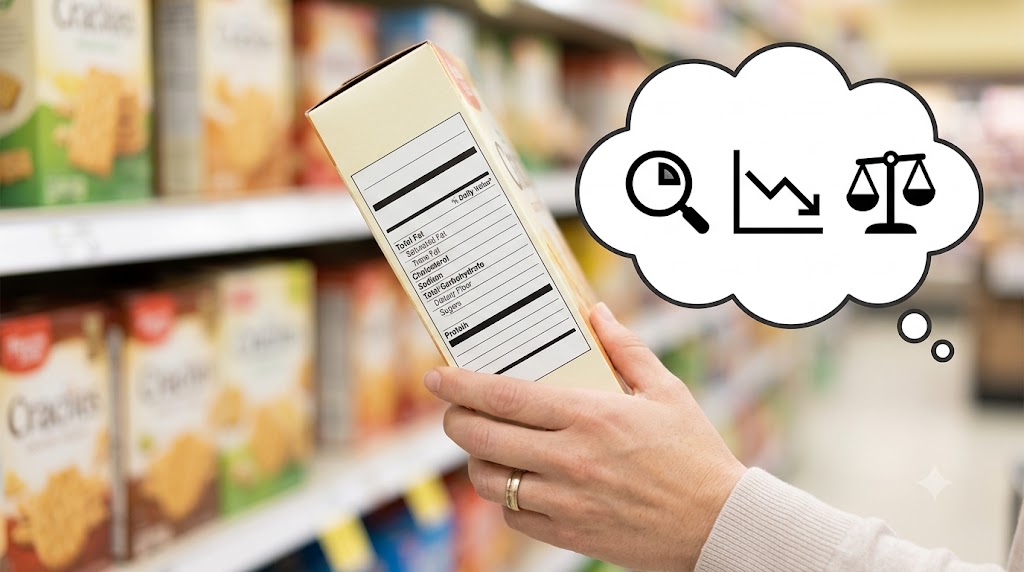
Misreading nutrition labels is far more common than most people realize — and it’s quietly sabotaging the healthy eating efforts of millions of people who are genuinely trying to make better food choices.
You stand in the grocery store aisle. You flip over the package. You look at the nutrition facts. You see some numbers. You make a decision. And most of the time — if you’re like the majority of shoppers — you’re drawing the wrong conclusion from what you’re looking at.
This isn’t a matter of intelligence. The nutrition facts label is genuinely confusing — it’s designed to comply with regulations, not to communicate health information clearly. And the food industry has become extraordinarily sophisticated at packaging products to look healthy while the fine print tells a very different story.
Here are the 3 biggest nutrition label mistakes most people make — and exactly how to read labels in a way that actually serves your health goals.
Why Nutrition Labels Are So Confusing in the First Place
Before diving into the mistakes, it helps to understand why reading nutrition labels is harder than it should be.
The nutrition facts label was designed primarily for regulatory compliance — not for consumer clarity. It reflects nutritional science that in some areas is decades old, uses measurement units that most people can’t intuitively interpret (milligrams, micrograms, percent daily values), and omits some of the most important information about food quality while highlighting less meaningful numbers.
On top of this, food marketing layered over the label — the claims on the front of the package — is deliberately designed to create positive impressions that the actual nutrition label doesn’t always support. “Natural,” “multigrain,” “reduced fat,” “no added sugar,” “made with real fruit” — these front-of-package claims are largely unregulated and frequently misleading.
The result: shoppers who believe they’re making informed, health-supporting choices based on label reading are often being misled — not by accident, but by design.
Mistake #1: Looking Only at Calories Per Serving — Without Checking the Serving Size
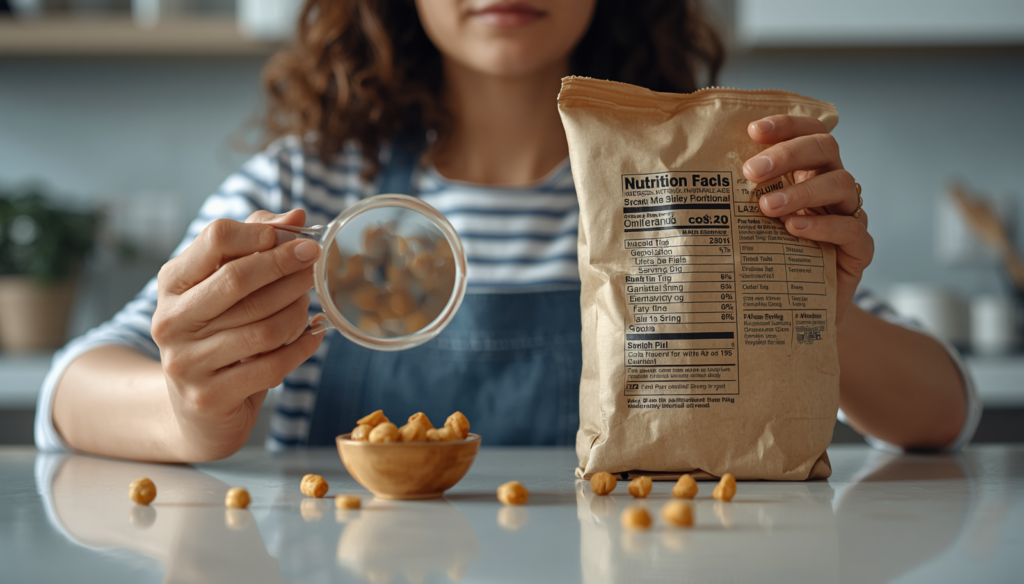
This is the single most exploited nutrition label trick in the food industry — and it catches out even health-conscious, label-reading shoppers with remarkable regularity.
The Serving Size Problem
Here’s how it works: A bag of chips shows 140 calories per serving on the nutrition label. That sounds manageable. You eat what feels like a normal portion. But buried in small print at the top of the nutrition facts panel, the serving size is listed as 28 grams (about 11 chips).
If you ate what most people would consider a normal portion — say, a third of the bag — you’ve actually consumed 3–4 servings, or 420–560 calories. From chips.
This isn’t an isolated example. Serving sizes on food packaging are frequently set at unrealistically small amounts that make calorie, sugar, and sodium numbers look more favorable than they are in practice.
The rule: Always check serving size FIRST — before looking at any other number on the label. Then ask yourself honestly: is this how much of this food I actually eat in one sitting? If you typically consume double the stated serving size, double every number on the label.
The “Per Container” Trick
Some products — particularly beverages and snack foods — label a single container as containing 2 or more servings, even when the packaging strongly implies it’s meant to be consumed at once.
A 20oz bottle of soda labeled as 2.5 servings with 100 calories per serving actually contains 250 calories — a fact that most people drinking the bottle in one sitting don’t register.
The fix: Look at both the per-serving AND per-container columns if listed. For beverages and single-serving snacks, calculate total calories and nutrients for the entire package — because that’s how much you’re probably consuming.
Mistake #2: Focusing on Total Fat While Ignoring What Kind of Fat
The “low fat” era of the 1990s left a lasting and damaging legacy in how people read nutrition labels. Millions of people still scan labels for total fat content — treating high fat as a red flag regardless of the type of fat — while ignoring the distinctions that actually matter for health.
Why Total Fat Is Largely Meaningless
Total fat content on a nutrition label tells you almost nothing useful about whether a food is healthy. This is because different types of fat have dramatically different effects on health — and lumping them together under “total fat” obscures all of the important information.
The fats that matter:
Saturated fat: Found primarily in animal products and tropical oils. Associated with elevated LDL cholesterol at high intakes. Worth monitoring — the general recommendation is to keep it below 10% of daily calories (roughly 22 grams on a 2,000-calorie diet).
Trans fat: The most harmful dietary fat — industrially produced through hydrogenation. Associated with elevated LDL and reduced HDL cholesterol, and significantly elevated cardiovascular risk. Any amount is problematic. Look for “0g trans fat” — but read the ingredient list too (more on this below).
Unsaturated fat (mono and polyunsaturated): The “good” fats found in olive oil, avocados, nuts, seeds, and fatty fish. Associated with cardiovascular protection, reduced inflammation, and improved cholesterol profiles. These are fats you want.
A food can be high in total fat but extremely healthy — like salmon, avocados, or nuts — because the fat is primarily unsaturated. A food can be low in total fat but genuinely harmful — like many low-fat cookies and crackers that replaced fat with refined sugar and starch.
The fix: Ignore total fat. Look specifically at saturated fat and trans fat on the label. If saturated fat is high relative to the serving size, that’s worth noting. If trans fat appears, avoid the product. Unsaturated fats need not concern you.
The Hidden Trans Fat Loophole
Here’s a critical detail: A product can legally claim “0g trans fat” on its label if it contains less than 0.5 grams per serving. This sounds trivial — but if you’re eating 3 servings, you could be consuming up to 1.5 grams of trans fat from a product labeled as trans fat-free.
The fix: If a product claims 0g trans fat, check the ingredient list for “partially hydrogenated oil” — the primary source of industrial trans fat. If it appears anywhere in the ingredient list, the product contains trans fat regardless of what the label says.
Mistake #3: Trusting “Per Daily Value” Percentages Without Understanding What They Mean
The % Daily Value (%DV) column on nutrition labels is one of the most misunderstood elements of the nutrition facts panel — and using it incorrectly leads to systematic errors in assessing whether a food is healthy.
What % Daily Value Actually Means
The %DV numbers tell you what percentage of a daily reference intake each nutrient provides, based on a 2,000-calorie-per-day diet. This reference diet was established for regulatory purposes and may or may not reflect your actual caloric needs.
The problem: most people interpret %DV as a measure of how good or bad a food is — higher %DV for nutrients = more of that nutrient — without understanding that for some nutrients, high %DV is desirable, while for others it’s a red flag.
Nutrients where HIGH %DV is desirable:
- Fiber — aim for foods that contribute meaningfully to the 38g/day (men) or 25g/day (women) recommendation
- Potassium — most Americans are deficient; high %DV is beneficial
- Vitamin D — most Americans don’t get enough
- Calcium, Iron, and other micronutrients listed at the bottom of the label
Nutrients where HIGH %DV is concerning:
- Sodium — the daily reference is 2,300mg. A single food item with 30–40% DV is contributing a large proportion of your daily sodium budget
- Saturated fat — the reference is roughly 20g/day. A food with 25% DV of saturated fat is delivering 5g in one serving
- Added sugars — the reference is 50g/day (10% of a 2,000-calorie diet). This is already a generous threshold — foods that use a significant %DV here should be minimized
The Added Sugar Distinction
One of the most important 2020 label update changes was the addition of a separate “Added Sugars” line beneath “Total Sugars.” This distinction matters enormously.
Total sugars includes both naturally occurring sugars (like lactose in milk or fructose in fruit) and added sugars. Added sugars are those introduced during manufacturing — refined sugar, high-fructose corn syrup, dextrose, honey, agave, and others.
Naturally occurring sugars in whole foods come packaged with fiber, protein, vitamins, and minerals that modulate their health impact. Added sugars do none of this — they’re empty calories that spike blood glucose and drive insulin resistance.
The fix: Look at added sugars specifically, not total sugars. A yogurt with 12g total sugar but 0g added sugar is getting all its sweetness from naturally occurring lactose — a very different product from a yogurt with 12g total sugar including 10g added sugar, despite looking identical on a quick scan.
The Ingredient List: The Most Important Part Nobody Reads
Here’s a truth about nutrition label reading that most people miss: the ingredient list is often more informative than the nutrition facts panel.
The ingredient list reveals what the food is actually made of — which the nutrition facts panel, focused on quantified nutrients, often obscures.
Key ingredient list strategies:
Check length and complexity. A short ingredient list of recognizable whole food ingredients is generally a good sign. A long list of chemicals, additives, emulsifiers, and artificial ingredients — regardless of what the nutrition facts say — is characteristic of ultra-processed food.
Ingredients are listed in order of weight. The first ingredient is present in the highest quantity. If sugar (in any of its many forms) appears in the first 3 ingredients, the product is primarily sweetened regardless of what the nutrition facts suggest.
Know sugar’s aliases. Sugar appears on ingredient lists under over 60 different names — including high-fructose corn syrup, dextrose, maltose, sucrose, cane juice, rice syrup, and many others. When multiple sugar sources appear spread throughout the ingredient list, the total sugar content may be higher than any single listing suggests.
Watch for partially hydrogenated oils. As discussed above, this phrase in the ingredient list means trans fat is present — regardless of the “0g trans fat” claim on the label.
A Quick Label-Reading Framework
Here’s a simple 5-step process for reading nutrition labels effectively:
- Check serving size first — determine how many servings you’ll actually consume and multiply accordingly
- Look at added sugars — anything above 5–6g per serving warrants scrutiny for a food that isn’t a dessert
- Check sodium — keep individual items below 15–20% DV unless it’s a complete meal
- Look at saturated fat and trans fat — ignore total fat
- Read the ingredient list — short, recognizable ingredients = better; long, chemical-heavy list = ultra-processed, regardless of what the numbers say
Frequently Asked Questions (FAQ)
Q: What is the most important thing to look for on a nutrition label? A: The serving size — because every other number on the label is meaningless without knowing how many servings you’re actually consuming. After that, added sugars, sodium, and the ingredient list provide the most actionable health information.
Q: Is the % Daily Value based on my personal needs? A: No — %DV is based on a 2,000-calorie reference diet established for labeling purposes. If you need significantly more or fewer calories than 2,000 per day, the %DV figures won’t accurately reflect your personal nutritional needs.
Q: Why do some products say “0g trans fat” but still contain partially hydrogenated oil? A: Because FDA regulations allow products containing less than 0.5g of trans fat per serving to claim “0g trans fat.” If serving sizes are small or if you eat multiple servings, these sub-threshold amounts can accumulate meaningfully. Always check the ingredient list for partially hydrogenated oil.
Q: Is “no added sugar” the same as “sugar-free”? A: No. “No added sugar” means no sugar was added during manufacturing — but the product may still contain significant natural sugars (like fruit juice or dried fruit). “Sugar-free” means the product contains less than 0.5g of sugar per serving — though it may contain artificial sweeteners.
Q: How much sodium is too much in a single food item? A: As a general guideline, keeping individual food items below 15–20% DV for sodium (approximately 350–460mg per serving) allows you to stay within the 2,300mg daily limit across a full day of eating. Foods with 30%+ DV for sodium per serving should be occasional rather than daily choices.
Q: Do organic or “natural” labels mean a food is healthy? A: Not necessarily. “Organic” refers to farming and production methods — not nutritional quality. An organic cookie is still a cookie. “Natural” is largely an unregulated marketing term with no consistent legal definition. Neither label tells you anything reliable about the nutritional quality of the food.
The Bottom Line
Misreading nutrition labels is one of the most common and consequential mistakes in everyday health decision-making — and the 3 mistakes above (ignoring serving sizes, fixating on total fat, and misusing %DV) account for the majority of label-reading errors that derail otherwise well-intentioned healthy eating.
The fix isn’t complicated — but it does require shifting your attention from the numbers the food industry wants you to focus on, to the numbers that actually matter for your health.
Check serving size first. Look at added sugars and sodium specifically. Read the ingredient list. These 3 habits will make you a dramatically more informed food shopper — and will help ensure that what you think you’re eating is actually what you’re eating.
The food system is not designed to make healthy choices easy. But armed with the right label-reading skills, you can navigate it far more effectively than most people ever do