
Microplastics and brain health are now at the center of one of the most alarming areas of emerging health research — and the findings are raising urgent questions about an invisible threat most of us are ingesting every single day.
New research has found microplastics — tiny plastic fragments less than 5 millimeters in size — not only in our food, water, and air, but inside human brain tissue, lungs, blood, placentas, and even breast milk. And what’s happening inside the brain when these particles accumulate is deeply concerning.
Scientists have found that microplastics can trigger neuroinflammation — inflammation inside the brain — and may be linked to the development and progression of Alzheimer’s disease and Parkinson’s disease — 2 of the most devastating neurological conditions affecting hundreds of millions of people worldwide.
This is no longer a future risk. It’s happening now, inside your body, and the scale of exposure is staggering. Here’s what the science says — and what you can actually do about it.
How Pervasive Are Microplastics — Really?
The ubiquity of microplastics in the human body is one of the most disturbing environmental health stories of our time. Here’s what recent research has found:
- The average person ingests approximately 5 grams of microplastics per week — equivalent to the weight of a credit card
- Microplastics have been detected in human blood (in 77% of donors tested in a 2022 study)
- They’ve been found in human lung tissue, including deep in the lungs where no foreign particles should be able to reach
- Microplastics have been detected in human placentas — meaning unborn babies are exposed before birth
- They’ve been found in breast milk — meaning newborns are exposed through feeding
- A 2024 landmark study found microplastics in human brain tissue — with concentrations approximately 7–30 times higher in the brains of people who died with dementia compared to those without
- The average human brain now contains approximately 0.5% plastic by weight according to some estimates — a figure that has increased dramatically over recent decades as plastic production has surged
These findings represent a dramatic acceleration in scientific understanding of microplastic exposure. Just 5 years ago, scientists weren’t certain microplastics could cross the blood-brain barrier. Now we have direct evidence that they do — and that they accumulate there.
What Microplastics Do to the Brain: The Mechanisms
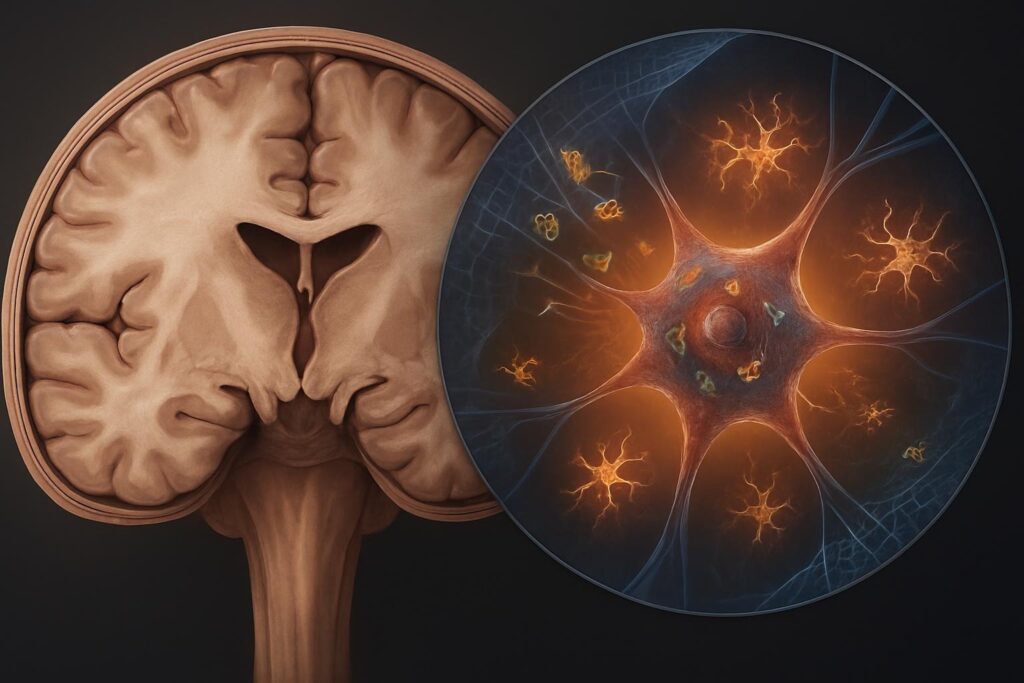
Understanding why microplastics are dangerous to brain health requires looking at the specific mechanisms through which they cause harm.
1. Neuroinflammation
This is the most significant and well-documented mechanism. When microplastics enter brain tissue, the brain’s immune cells — microglia — recognize them as foreign objects and mount an inflammatory response.
The problem: the brain cannot easily clear these particles the way the body clears other foreign materials. Microplastics persist in brain tissue, creating a chronic, smoldering inflammatory response — chronic neuroinflammation — that has been increasingly linked to the development of Alzheimer’s disease, Parkinson’s disease, depression, cognitive decline, and other neurological conditions.
2. Disruption of the Blood-Brain Barrier
The blood-brain barrier (BBB) is a highly selective protective membrane that prevents most foreign substances from entering the brain. Research shows that microplastics — particularly nanoplastics, which are even smaller — can physically disrupt the blood-brain barrier, making it more permeable and allowing other harmful substances (toxins, pathogens, inflammatory molecules) to enter the brain more easily.
3. Oxidative Stress
Microplastics generate reactive oxygen species (ROS) in brain tissue — unstable molecules that damage neurons and other brain cells through oxidative stress. Oxidative stress is a key driver of neuronal death in both Alzheimer’s and Parkinson’s disease.
4. Chemical Toxicity
Microplastics are not inert. They act as carriers for toxic chemicals — including plasticizers (like phthalates and BPA), flame retardants, heavy metals, and persistent organic pollutants that adsorb onto plastic surfaces from the environment. When microplastics reach brain tissue, they release these chemical payloads directly into a highly sensitive environment.
5. Protein Aggregation Interference
Emerging research suggests microplastics may interfere with the clearance of amyloid beta and alpha-synuclein — the misfolded proteins that form the plaques and tangles characteristic of Alzheimer’s and Parkinson’s disease respectively. This could accelerate the protein aggregation that drives disease progression.
The Alzheimer’s and Parkinson’s Connection
The finding that brain tissue from people with dementia contains 7–30 times more microplastics than neurologically healthy individuals is striking — but it raises an important question: are microplastics causing these diseases, or are they simply accumulating in already-diseased brains?
The honest scientific answer is: we don’t yet know definitively. The research is observational, and causation has not been proven in humans. However, several lines of evidence support a causal hypothesis:
Animal studies show direct causation: In animal models, exposure to microplastics produces neuroinflammation, cognitive impairment, and accumulation of amyloid-like proteins — changes consistent with early Alzheimer’s pathology.
The timeline fits: Human exposure to microplastics has increased exponentially since the 1950s — roughly parallel to the dramatic increase in Alzheimer’s and Parkinson’s disease prevalence over the same period. While correlation doesn’t establish causation, the parallel trends are concerning.
The mechanisms are plausible: The neuroinflammation, oxidative stress, and blood-brain barrier disruption produced by microplastics are exactly the kinds of biological changes that drive neurodegeneration. The mechanistic link is coherent.
Dose-dependent effects in animals: Animal studies show that higher microplastic doses produce more severe neurological effects — consistent with a causal relationship.
Most neuroscientists now consider microplastic exposure a plausible contributing factor to neurodegeneration — one that warrants serious research attention and precautionary action even before definitive causation is established.
Where Microplastics Come From: Your Biggest Sources of Exposure
Understanding your exposure sources is the first step toward reducing them:
Food and water — the largest source:
- Bottled water contains on average 240 microplastic particles per liter — dramatically more than tap water
- Seafood — particularly shellfish, which filter-feed in plastic-contaminated water
- Sea salt — one of the most microplastic-contaminated foods tested
- Canned foods — plastic lining in cans leaches into food, particularly when acidic
- Foods cooked or stored in plastic containers — especially when heated
Indoor air:
- Synthetic textiles (polyester, nylon, fleece) shed microfibers with every wash and wear
- Plastic household items, furniture, and electronics off-gas plastic particles
- Indoor air consistently contains more microplastics than outdoor air
Packaging:
- Plastic food packaging, particularly when heated in the microwave
- Plastic cutting boards — which shed microplastics into food during cutting
- Coffee capsules and single-use coffee cups with plastic lining
Personal care products:
- Microbeads in exfoliating products (though largely banned in many countries)
- Synthetic ingredients in cosmetics and personal care products
8 Science-Backed Ways to Reduce Your Microplastic Exposure
While it’s impossible to eliminate microplastic exposure entirely in the modern world, meaningful reductions are achievable with deliberate changes:
1. Switch from Bottled Water to Filtered Tap Water
This is the single highest-impact change most people can make. Bottled water contains dramatically more microplastics than filtered tap water — and switching saves money and plastic waste simultaneously.
Invest in a quality water filter: reverse osmosis systems remove the highest percentage of microplastics. Countertop filters with activated carbon and fine filtration also provide meaningful reduction.
2. Never Heat Food in Plastic Containers
Heating plastic dramatically accelerates the leaching of microplastics and chemical additives into food. Use glass, ceramic, or stainless steel containers for heating food — always. Even “microwave-safe” plastic still leaches particles when heated; “microwave-safe” means it won’t melt, not that it won’t leach.
3. Use a Glass or Stainless Steel Water Bottle
Replace disposable plastic bottles and plastic reusable bottles with glass or stainless steel. This eliminates 1 of the most consistent daily sources of microplastic ingestion.
4. Replace Plastic Cutting Boards with Wood or Bamboo
Every cut on a plastic cutting board sheds microplastic particles directly into your food. Wood and bamboo cutting boards don’t have this problem and are naturally antimicrobial.
5. Filter Your Indoor Air
A HEPA air purifier in your bedroom and main living space captures airborne microplastic fibers before you breathe them in. Given that indoor air contains more microplastics than outdoor air, this is a meaningful exposure reduction strategy.
6. Wash Synthetic Clothes in a Microplastic-Catching Laundry Bag
Guppyfriend bags and similar products capture the microfibers shed by synthetic clothing during washing — preventing them from entering the water supply and reducing the microplastic load in your laundry environment.
7. Choose Natural Fiber Clothing and Textiles
Choosing cotton, wool, linen, and other natural fibers over polyester, nylon, and fleece reduces the microfiber shedding in your home environment — both from clothing and from furniture and bedding.
8. Eat Lower on the Marine Food Chain
Microplastic contamination concentrates up the food chain. Smaller fish (sardines, anchovies, mackerel) and plant-based seafood alternatives contain fewer accumulated plastic contaminants than large predatory fish and filter-feeding shellfish.
Frequently Asked Questions (FAQ)
Q: Can microplastics really cross the blood-brain barrier? A: Yes — research has now confirmed that nanoplastics (the smallest microplastic particles) can cross the blood-brain barrier and accumulate in brain tissue. This was a major scientific discovery that substantially elevated concern about microplastics as a neurological health threat.
Q: How much microplastic does the average person have in their brain? A: Recent research suggests the average human brain contains measurable quantities of microplastics — with some estimates suggesting plastic now constitutes approximately 0.5% of brain weight in some individuals. Concentrations appear to be significantly higher in people with dementia.
Q: Does cooking with plastic utensils increase microplastic exposure? A: Yes — particularly when plastic utensils come into contact with hot food. Nylon and other plastic cooking utensils shed microplastic particles into food during use, especially at high temperatures. Switching to wood, bamboo, or stainless steel cooking utensils reduces this exposure.
Q: Is tap water safer than bottled water for microplastics? A: Generally yes — filtered tap water contains significantly fewer microplastics than bottled water. The plastic bottle itself is a major source of microplastic contamination in bottled water. Reverse osmosis filtration of tap water provides the lowest microplastic exposure of commonly available drinking water options.
Q: Can the body eliminate microplastics once they’re in the brain? A: The brain has limited capacity to clear microplastics once they’ve crossed the blood-brain barrier. The glymphatic system — the brain’s waste clearance network, active primarily during deep sleep — may provide some clearance capacity, but the evidence for effective microplastic clearance from brain tissue is limited.
Q: Are children more vulnerable to microplastic brain effects than adults? A: Likely yes. Children’s blood-brain barriers are more permeable than adults’, and their developing brains may be more sensitive to inflammatory disruption. Additionally, children’s smaller body mass means that equivalent microplastic ingestion represents a higher dose relative to body weight.
The Bottom Line
Microplastics and brain health represent 1 of the most urgent emerging public health concerns of our time — and the research trajectory is deeply concerning. We now have direct evidence that microplastics accumulate in human brain tissue, trigger neuroinflammation, and are found in dramatically higher concentrations in people with dementia.
Whether microplastics are a contributing cause of Alzheimer’s and Parkinson’s disease — or merely a marker of broader environmental exposure — has not been definitively established. But the mechanistic plausibility is strong, the animal evidence is consistent, and the precautionary principle clearly supports reducing exposure now.
The 8 strategies above — filtered tap water, glass containers, avoiding heated plastic, HEPA filtration, and natural fiber choices — can meaningfully reduce your daily microplastic load without requiring radical lifestyle changes.
You can’t opt out of the world that has put plastic in your blood and your brain. But you can choose, deliberately and consistently, to reduce how much more gets in.
Start with your water bottle. Start today.