
If you’ve ever wondered how to build a habit that sticks after yet another failed attempt — a workout routine abandoned by week three, a meditation app deleted after ten days, a “new year, new me” plan quietly dissolved by February — you’ve probably also encountered the popular claim that it takes 21 days to build a habit.
Here’s the honest truth: that number isn’t actually supported by the research it’s commonly attributed to. The real science of habit formation is more nuanced, considerably more useful, and explains exactly why so many well-intentioned habits fail — not because of weak willpower, but because of a flawed approach to building them in the first place.
Where the “21 Days” Myth Actually Comes From
The 21-day claim traces back to a 1960s plastic surgeon’s observations about how long it took his patients to adjust to changes in their appearance — an interesting but entirely unrelated observation that somehow got generalized into a universal habit-formation rule over the following decades.
The actual research tells a very different story. A widely cited study from University College London tracking real habit formation found that, on average, it took participants 66 days for a new behavior to become automatic — and the range was enormous, from as few as 18 days to as many as 254 days, depending on the behavior and the person.
The takeaway: there’s no fixed universal timeline, and habits that feel hard after three weeks aren’t a sign of failure. They’re a sign you’re still in the normal window of habit formation.
Why Most Habit Attempts Actually Fail

Understanding the real reasons habits fail is far more useful than memorizing a magic number of days.
The habit was too big from day one
The most common failure pattern: an ambitious new habit — an hour at the gym daily, a complete diet overhaul, meditating for 30 minutes every morning — that requires too much willpower to sustain once initial motivation fades, which it reliably does for everyone, regardless of how committed they feel at the start.
There was no clear trigger
Habits that rely on remembering to do them, rather than being tied to an existing cue, are dramatically less likely to stick. “I’ll exercise sometime today” is far weaker than “I’ll do 10 squats right after I brush my teeth in the morning” — the second version has a built-in trigger that doesn’t depend on willpower or memory.
The reward was too delayed or unclear
Habits tied to long-term, abstract outcomes (better health in a year, a smaller waist size eventually) struggle to compete against the brain’s strong preference for immediate, tangible feedback. Without some form of more immediate reward or satisfaction built in, motivation tends to fade well before the long-term benefit becomes apparent.
All-or-nothing thinking derailed the streak
Missing a single day often triggers a disproportionate response — treating one missed day as total failure and abandoning the habit entirely, rather than simply resuming the next day. This pattern, sometimes called the “what the hell effect,” is one of the most common reasons otherwise well-designed habits collapse.
What Actually Works: The Real Mechanics of Habit Formation
Start dramatically smaller than feels necessary
The most consistently effective strategy across habit research is starting with a version of the habit so small it feels almost too easy. Not “exercise for 30 minutes” but “put on your workout clothes.” Not “meditate for 20 minutes” but “sit quietly for 60 seconds.” This isn’t a permanent ceiling — it’s a deliberately low-friction starting point designed to build consistency first, with intensity added gradually once the habit itself is genuinely automatic.
This approach works because consistency, not intensity, is what actually wires a habit into automatic behavior. A small action done daily builds the neural pathway far more effectively than an ambitious action done sporadically.
Anchor the new habit to an existing one
Habits stick far more reliably when they’re attached to something you already do consistently, rather than floating freely in your day waiting to be remembered. The formula: “After I [existing habit], I will [new habit].” After I pour my morning coffee, I will write down one thing I’m grateful for. After I sit down at my desk, I will drink a full glass of water. This technique, sometimes called habit stacking, leverages an existing automatic behavior as the trigger for the new one.
Make the habit visible and easy
Small environmental adjustments dramatically affect whether a habit actually happens. Leaving workout shoes by the door, keeping a water bottle visibly on your desk, placing a book on your pillow instead of your phone — these small frictionless cues make the desired behavior the path of least resistance, rather than requiring active willpower to initiate every single time.
Track it, even simply
Visibly tracking a habit — a simple checkmark on a calendar, a habit-tracking app, a tally on a sticky note — creates a tangible, immediate form of feedback that the long-term outcome alone can’t provide. Watching a streak build is genuinely motivating in a way that abstract future benefits often aren’t, and it gives you real-time information about your own consistency rather than relying on memory or vague impressions.
Plan explicitly for missed days
Since missing a day is essentially inevitable over any meaningful stretch of time, deciding in advance how you’ll handle it removes the emotional derailment that often follows a slip. A simple, pre-decided rule — “if I miss a day, I just resume the next day, no story attached” — prevents the all-or-nothing collapse that ends so many otherwise well-built habits.
Applying This to Real Health Habits
This framework isn’t abstract — it applies directly to building the kinds of habits covered elsewhere on this site. If you’re working on consistent movement, our Japanese walking method guide is a genuinely low-barrier starting point — exactly the kind of “small enough to actually do” habit this research points toward, rather than an intense workout plan likely to be abandoned within weeks.
If stress management is the habit you’re trying to build, our guide on managing stress and anxiety includes specific, small techniques — like a brief grounding exercise — that fit the same “start small, anchor to an existing routine” model far better than an ambitious daily meditation practice would for most beginners.
And if low energy has been making any new habit feel harder to start, it’s worth ruling out whether something physiological is contributing — our piece on why you’re always tired covers the most common, correctable causes.
A Realistic Way to Start
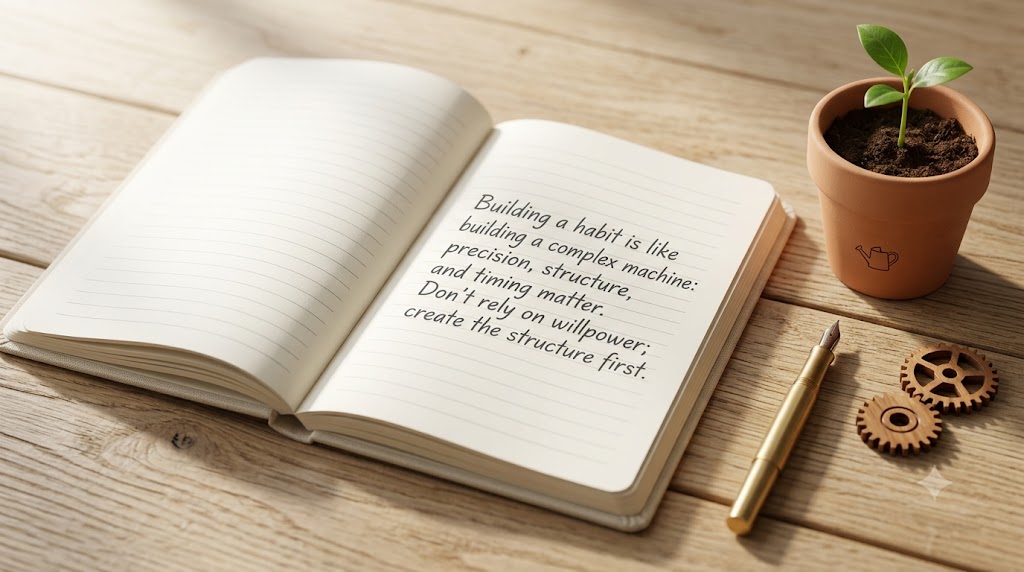
Pick exactly one habit — not three, not five. Make it embarrassingly small. Anchor it to something you already do every day without fail. Track it simply. And decide in advance that missing a day means resuming tomorrow, not starting over from scratch or abandoning it entirely.
Given that real habit formation research points to anywhere from 18 to over 200 days depending on the behavior, the goal isn’t to rush the timeline — it’s to build something genuinely sustainable enough to still be standing on day 90, rather than something ambitious enough to look impressive on day one and gone by day ten.
“For more no-fluff practical guides on building better habits and beating procrastination, check out our health and wellness books guide.”
Frequently Asked Questions
Is it true that it takes exactly 21 days to build a habit? No — this is a widely repeated myth with no solid scientific backing. Real research suggests an average closer to 66 days, with significant variation (18 to over 250 days) depending on the specific habit and individual.
What if I miss several days in a row, not just one? The same principle applies, just with more self-compassion required. Resume with the smallest possible version of the habit rather than trying to immediately jump back to full intensity, and avoid treating the gap as evidence the habit “didn’t work” — inconsistent effort doesn’t erase the neural groundwork already built.
Can I build multiple habits at the same time? It’s possible, but research generally supports focusing on one habit at a time, or at most two, for the highest success rate. Attempting several significant new habits simultaneously spreads willpower and attention too thin, reducing the odds that any of them become genuinely automatic.
How small is “too small” to even count as a real habit? There’s no such thing as too small at the start. A habit that takes 30 seconds and happens consistently is doing far more for long-term change than an ambitious version that gets abandoned after a week. Intensity can always be added later once consistency is genuinely established.