White noise pink noise brown noise sleep trends have exploded in popularity — filling TikTok feeds, Spotify playlists, and YouTube channels with hours of static, rumbles, and hums that millions of people swear are transforming their sleep quality.
But with so many options flooding the market — white noise machines, pink noise apps, brown noise videos, “sleep sounds” playlists promising deep rest — it’s easy to get lost in the noise (pun intended) without understanding what the science actually says.
Do these sounds genuinely improve sleep? Is one type better than the others? And are there any risks to sleeping with constant background sound every night?
Here’s a clear, science-backed breakdown of everything you need to know about white, pink, and brown noise for sleep — and how to figure out which one might actually work for you.
What Are White, Pink, and Brown Noise — And What Makes Them Different?
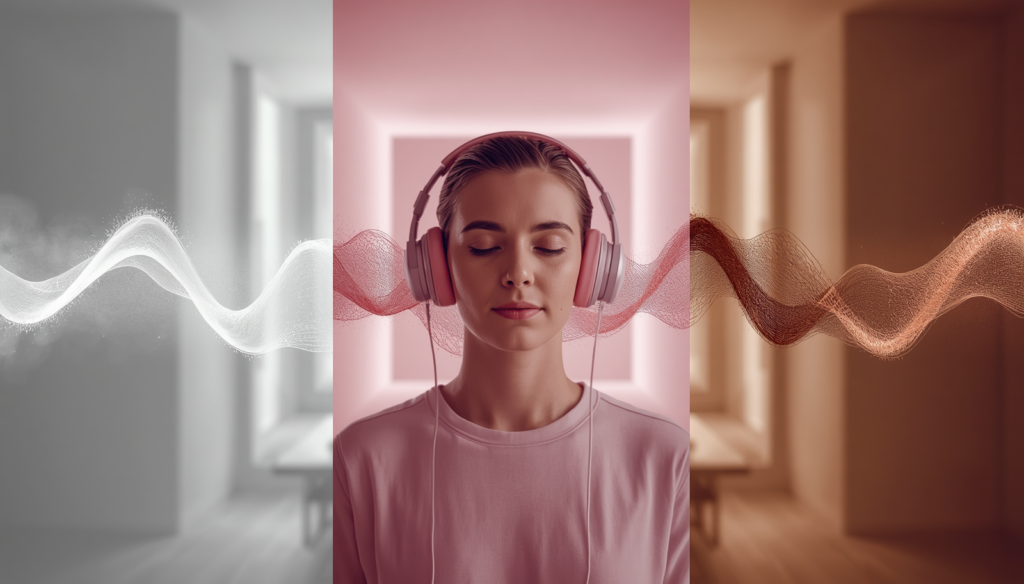
The different “colors” of noise refer to how the energy of the sound is distributed across different frequencies. Just as different colors of light have different wavelengths, different colors of noise have different frequency profiles — which is why they sound distinct and produce different subjective effects.
White Noise
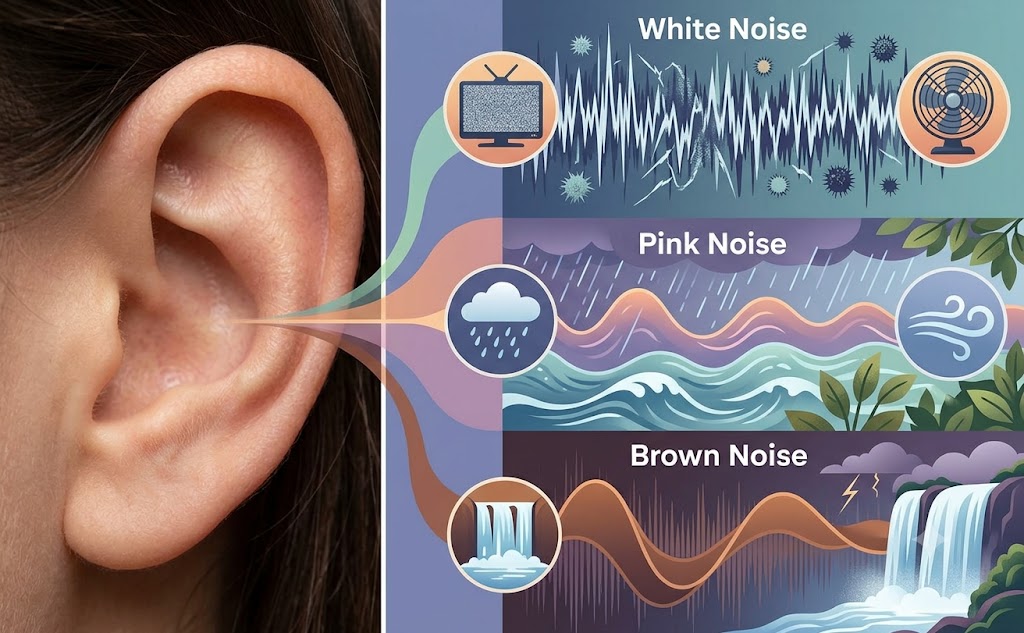
White noise contains equal energy at all frequencies across the audible spectrum — from the lowest to the highest sounds the human ear can detect.
The result: a harsh, high-pitched, static-like sound — similar to an air conditioner, a fan on high speed, or the static between radio stations. White noise emphasizes higher frequencies, which gives it its characteristic sharp, slightly aggressive quality.
Analogy: White noise is like white light — which contains equal amounts of all colors (frequencies) of light simultaneously.
Pink Noise
Pink noise has more energy at lower frequencies than white noise — specifically, the energy decreases by 3 decibels with each doubling of frequency. This means bass frequencies are louder relative to treble frequencies.
The result: a softer, more natural-sounding noise — closer to rainfall, rustling leaves, steady wind, or waves on a beach. Pink noise is generally perceived as more pleasant and less harsh than white noise because it better matches the natural acoustic environment that humans evolved in.
Analogy: Pink noise is like the sound of rain — it has more low-frequency rumble than high-pitched hiss.
Brown Noise (Brownian Noise)
Brown noise (also called Brownian noise or red noise) has even more energy concentrated at lower frequencies than pink noise — energy decreases by 6 decibels per doubling of frequency. This creates a deep, rumbling, bass-heavy sound.
The result: a powerful, low-frequency sound similar to strong wind, distant thunder, or the deep hum of a large engine. Brown noise has a warm, enveloping quality that many people find deeply calming.
Note: Brown noise is named after Robert Brown (who discovered Brownian motion) — not the color brown. The “color” naming convention for noise types is simply a loose analogy to the light spectrum.
What Does the Science Say? The Research on Noise and Sleep
The research on noise and sleep quality is genuinely interesting — though it’s important to distinguish between well-established findings and preliminary data.
The Masking Effect — The Most Evidence-Based Benefit
The primary mechanism through which background noise improves sleep is auditory masking — reducing the disruptive contrast between ambient background sound and sudden loud noises (traffic, snoring partners, slamming doors, barking dogs).
Here’s the key insight: it’s not absolute sound level that wakes people up — it’s sudden changes in sound level. A room going from dead quiet to a sudden loud noise (a car alarm, a neighbor’s door slamming) triggers the brain’s arousal system and wakes you up. A consistent background noise raises the baseline sound level, making sudden noises less jarring by contrast — like how it’s harder to notice a spark against a bright background than against complete darkness.
This masking effect is well-established and applies to all types of steady background noise — white, pink, brown, or even consistent fan noise.
Pink Noise and Deep Sleep — The Most Promising Research
Of the 3 main noise colors, pink noise has the most research specifically examining its effects on sleep quality beyond simple masking.
A 2017 study published in Frontiers in Human Neuroscience found that pink noise synchronized with slow brain oscillations during deep sleep enhanced memory consolidation and improved subjective sleep quality in older adults.
A 2012 study in the Journal of Theoretical Biology found that pink noise significantly increased the proportion of deep (slow-wave) sleep and improved subjective sleep quality in young adults.
The proposed mechanism: pink noise may entrain the brain’s slow oscillations during deep sleep — the neural patterns associated with memory consolidation and physical restoration — potentially enhancing the quality of sleep beyond simple noise masking.
Important caveat: These studies are small, and the pink noise sleep enhancement research is still in early stages. The findings are promising but not yet definitive enough to make strong clinical recommendations.
White Noise and Infant Sleep
White noise has the most established research specifically for infant sleep — where its womb-like quality appears to calm newborns and extend sleep duration. Multiple studies support the use of white noise for infant sleep, though it should be used at appropriate volumes (below 50 decibels, roughly the level of a quiet room) to avoid any risk to hearing development.
Brown Noise and Focus/ADHD
Brown noise has attracted significant attention for its potential benefits for focus and ADHD symptoms — a trend that went viral on social media in 2021–2022. Several people with ADHD report that brown noise dramatically improves concentration and reduces cognitive restlessness.
The research here is limited but biologically plausible — the theory being that brown noise’s deep frequency profile provides sufficient auditory stimulation to the reticular activating system without being distracting, reducing the brain’s tendency to seek stimulation elsewhere (a core feature of ADHD).
For sleep specifically, brown noise’s deep, enveloping quality is reported as highly effective for many people — particularly those who find white noise too harsh or stimulating.
Head-to-Head: White vs. Pink vs. Brown Noise for Sleep
| Feature | White Noise | Pink Noise | Brown Noise |
|---|---|---|---|
| Sound character | Sharp, high-pitched static | Soft, rain-like, natural | Deep, rumbling, bass-heavy |
| Masking effectiveness | High | High | High |
| Sleep quality research | Moderate | Most promising | Limited |
| Infant sleep research | Strong | Limited | Limited |
| ADHD/focus research | Limited | Limited | Most promising |
| Subjective pleasantness | Lower (can be harsh) | Higher (more natural) | High (warm, enveloping) |
| Best for | Light sleepers, noisy environments | Deep sleep enhancement, older adults | Heavy sleepers, focus, ADHD |
Which Noise Color Should You Choose?
The honest answer is: the one that helps you sleep. Individual response to different noise types varies significantly, and the best noise for sleep is ultimately subjective.
That said, here are some general guidelines:
Choose white noise if:
- You live in a very noisy environment and need maximum masking power
- You’re using it for infant sleep
- You already use a fan or air conditioner and find those sounds helpful
Choose pink noise if:
- You want the most research-supported option for sleep quality enhancement
- You find white noise too harsh or irritating
- You’re interested in potential deep sleep and memory consolidation benefits
- You prefer more natural-sounding audio
Choose brown noise if:
- You find white noise too stimulating and pink noise too subtle
- You have ADHD or tend toward a busy, restless mind
- You prefer deep, bass-heavy, enveloping sounds
- You want something that feels more like a physical, immersive sound environment
Try all 3: Many people find their preference through simple experimentation over a week or 2. Most sleep sound apps offer all 3 options — try each for a few nights and track how you feel the next morning.
Important Safety Considerations
Before committing to nightly noise sleep aids, there are a few important safety considerations:
Volume Matters — Significantly
The most important safety consideration for sleep noise is volume. Exposure to noise above 85 decibels over extended periods can cause hearing damage. Sleep sounds should be kept at 50–65 decibels maximum — roughly the volume of a quiet conversation or light rain.
Many white noise machines and apps can exceed safe levels. Measure the volume with a free decibel meter app (available for both iOS and Android) and ensure your sleep sound is well within the safe range.
For infants specifically: Keep any sound machine at a maximum of 50 decibels and position it at least 7 feet away from the crib. The American Academy of Pediatrics advises against placing sound machines directly next to infants.
Dependency Risk
Some people who use sleep sounds every night report difficulty sleeping without them — particularly when traveling or in unfamiliar environments. This isn’t dangerous, but it’s worth being aware of. If you use sleep sounds nightly, consider occasionally sleeping without them to maintain flexibility.
Not a Substitute for Addressing Underlying Sleep Issues
If you’re relying on sleep sounds to manage significant sleep problems — chronic insomnia, suspected sleep apnea, severe sleep anxiety — they’re at best a band-aid. Consider seeing a sleep specialist or pursuing CBT-I (cognitive behavioral therapy for insomnia), which addresses the underlying causes of sleep difficulties rather than just masking them.
When to See a Doctor
Consult a physician if:
- You’ve used sleep sounds consistently for 4+ weeks without meaningful improvement
- You wake up unrefreshed despite apparently adequate sleep hours
- You snore loudly or have been told you stop breathing during sleep (potential sleep apnea)
- Daytime sleepiness is significantly affecting your functioning
The Best Ways to Try Sleep Sounds
If you want to experiment with white, pink, or brown noise for sleep, here are the most accessible options:
Free options:
- YouTube — search for “8 hour brown noise,” “pink noise for sleep,” etc. Thousands of high-quality options
- Spotify and Apple Music — search “sleep sounds,” “white noise,” “brown noise” for extensive free playlists
- myNoise app — highly customizable, free with premium options
- Rain Rain Sleep Sounds — simple, well-designed free app
Dedicated white noise machines:
- LectroFan — widely considered the gold standard for white noise machines, with multiple sound options and precise volume control
- Marpac Dohm — uses an actual mechanical fan to produce natural white noise rather than a digital loop
- Hatch Restore — combines sound machine with smart alarm and light therapy
Smart speaker options:
- Ask Amazon Alexa or Google Home for “white noise,” “pink noise,” or “brown noise” — both provide instant, extended playback without phone screen exposure
Frequently Asked Questions (FAQ)
Q: Does white noise actually improve sleep quality? A: Yes — primarily through auditory masking, which reduces the disruptive impact of sudden environmental noises that would otherwise cause arousals. Pink noise has the most promising research for enhancing sleep quality beyond masking alone.
Q: Is it safe to play white noise all night? A: Yes, if kept at safe volumes — 50–65 decibels maximum for adults, 50 decibels maximum for infants. Measure with a decibel app to ensure you’re within the safe range.
Q: What’s the difference between white noise and pink noise? A: White noise has equal energy at all frequencies — producing a harsh, high-pitched static sound. Pink noise has more energy at lower frequencies — producing a softer, more natural sound similar to rainfall. Pink noise is generally perceived as more pleasant and has more research supporting deep sleep enhancement.
Q: Why is brown noise so calming for some people? A: Brown noise’s deep, bass-heavy character provides rich auditory stimulation at low frequencies — which many people find intrinsically calming and enveloping. It may also be particularly effective for people with ADHD by providing sufficient low-level stimulation to reduce cognitive restlessness without being distracting.
Q: Can children use white noise for sleep? A: Yes — but volume and distance are critical. Keep sound levels below 50 decibels and position the machine at least 7 feet from the child’s sleeping area. Never place a sound machine directly next to a crib or in a child’s bed.
Q: Will I become dependent on white noise for sleep? A: Psychological dependence on sleep sounds can develop — some people find it harder to sleep without them after using them nightly. This isn’t dangerous but can be inconvenient. Occasional nights without the sound machine help maintain flexibility.
The Bottom Line
White noise, pink noise, and brown noise for sleep all work — primarily through the auditory masking mechanism that reduces the jarring contrast of sudden environmental sounds. Of the 3 types, pink noise has the most promising research for actively enhancing deep sleep quality beyond masking. Brown noise is particularly popular for its calming, enveloping character and potential focus benefits. White noise has the strongest evidence for infant sleep.
The most important thing: keep volumes safe (below 65 decibels for adults, below 50 for infants), experiment to find your preference, and use sleep sounds as a complement to — not a substitute for — the behavioral and environmental sleep optimization strategies that produce the deepest, most restorative sleep.
Your bedroom should be a sanctuary for recovery. Whether that sanctuary benefits from the gentle patter of pink rain, the deep rumble of brown thunder, or the steady hiss of white static — that’s a decision only your ears can make.
Try them all. Sleep well.