
Gum disease and breast cancer are now directly linked by science — and it’s one of the most startling discoveries in cancer research in recent years.
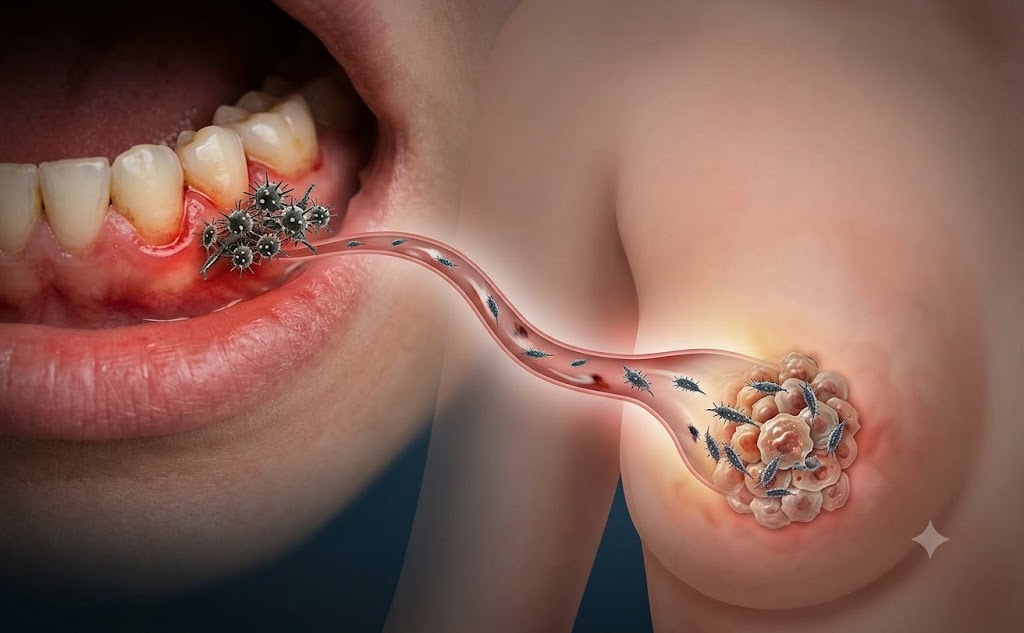
Researchers have found that Fusobacterium nucleatum — a bacterium commonly found in the mouth and one of the primary drivers of periodontal (gum) disease — can travel through the bloodstream, colonize breast tissue, and actively promote the growth and spread of breast cancer cells.
This isn’t a distant or theoretical risk. F. nucleatum has now been detected in breast tumor tissue in multiple studies, with higher concentrations correlating with more aggressive tumors, worse prognosis, and higher rates of chemotherapy resistance. The bacterium appears to do more than simply colonize breast tissue — it actively interferes with the immune system’s ability to detect and destroy cancer cells, potentially giving tumors a shield against the body’s natural defenses.
For the estimated 47.2% of American adults over 30 who have some form of periodontal disease, this research represents a genuinely important reason to take oral health far more seriously than most people currently do.
Here’s what the science shows — and what you can do about it.
What the Research Found
The study — conducted by researchers examining the microbiological profile of breast tumor tissue — used advanced DNA sequencing techniques to identify which bacteria were present in cancerous breast tissue compared to healthy breast tissue.
The key findings:
- F. nucleatum was significantly more prevalent in breast tumor tissue than in adjacent healthy tissue
- Patients with higher F. nucleatum concentrations in their tumors had measurably worse clinical outcomes — including higher recurrence rates and lower survival
- Laboratory experiments showed F. nucleatum directly stimulates breast cancer cell proliferation — helping cancer cells grow and divide more rapidly
- The bacterium appears to suppress local immune activity — reducing the infiltration of immune cells that would normally detect and attack cancer cells
- F. nucleatum activates specific molecular pathways in breast cancer cells — including the Wnt/β-catenin pathway — that drive cancer progression and metastasis
- Animal models confirmed that F. nucleatum accelerated tumor growth and increased metastatic spread compared to controls
The researchers proposed that F. nucleatum travels from the oral cavity to breast tissue via the bloodstream — a pathway that is facilitated by gum disease, which creates openings in the gum tissue that allow oral bacteria to enter the circulation.
What Is Fusobacterium Nucleatum — And Why Is It in Your Mouth?
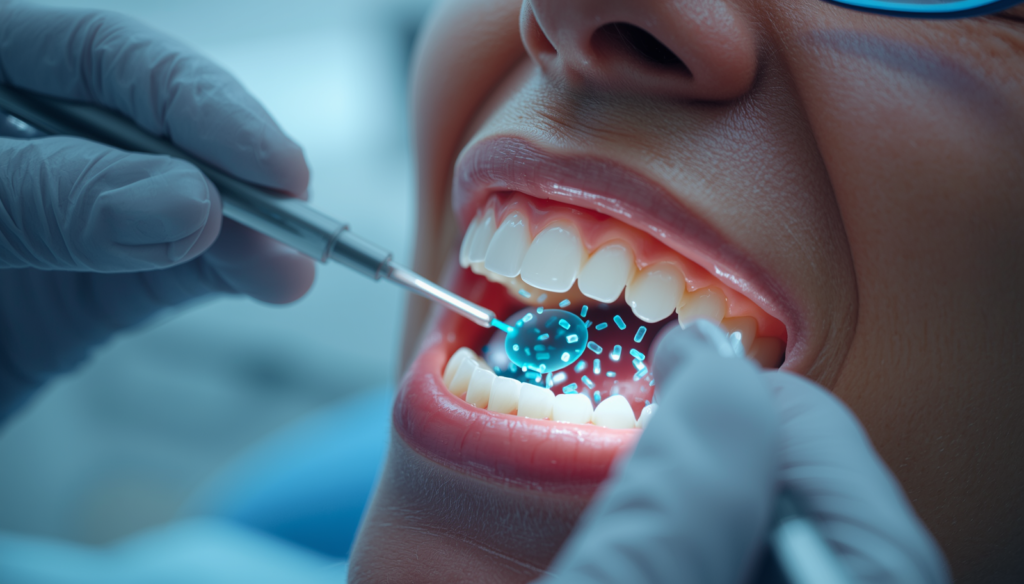
F. nucleatum is a gram-negative anaerobic bacterium that is a normal component of the oral microbiome in low concentrations. The problem arises when it overgrows — which happens in the context of poor oral hygiene and gum disease.
In healthy mouths with good oral hygiene, F. nucleatum is present in small, managed quantities. In mouths with periodontal disease — where bacterial biofilm (plaque) accumulates in pockets between teeth and gums, driving inflammation and gum tissue destruction — F. nucleatum can reach much higher concentrations.
This is the same mechanism by which gum disease was previously linked to heart disease: oral bacteria enter the bloodstream through inflamed, compromised gum tissue and travel to distant sites — in this case, the heart and coronary arteries. The breast cancer finding extends this principle to a new target organ.
F. nucleatum is particularly “sticky” — it has molecular adhesins that allow it to bind to a wide range of cell types, which may explain why it successfully colonizes sites as distant from the mouth as breast tissue.
This Is Not F. Nucleatum’s First Connection to Cancer
The breast cancer finding is alarming on its own — but it becomes even more significant when viewed in the context of F. nucleatum’s already-established role in another major cancer: colorectal cancer.
F. nucleatum was identified as a driver of colorectal cancer progression in landmark research published over the past decade:
- F. nucleatum is found in approximately 10% of all colorectal cancers
- Its presence in colorectal tumors is associated with worse prognosis and chemotherapy resistance
- The bacterium promotes colorectal cancer through the same Wnt/β-catenin pathway implicated in the breast cancer findings
- F. nucleatum survives chemotherapy in colorectal tumor tissue and contributes to cancer recurrence after treatment
The convergence of F. nucleatum’s role in both colorectal and breast cancer has elevated this oral bacterium to 1 of the most studied tumor microbiome organisms in cancer research — and has made gum disease a significantly more serious health concern than its name implies.
The Oral-Systemic Health Connection: Bigger Than Most People Realize
The gum disease–breast cancer link is the latest chapter in an increasingly compelling story about the connection between oral health and systemic disease. Here’s what else gum disease has been linked to:
Cardiovascular disease: Periodontal disease is associated with 2–3 times higher risk of heart attack and stroke. Oral bacteria — including F. nucleatum — have been found in arterial plaques, where they drive inflammation and contribute to atherosclerosis.
Type 2 diabetes: The relationship between gum disease and diabetes is bidirectional — diabetes impairs immune response and increases susceptibility to gum disease, while gum disease worsens blood sugar control and insulin resistance.
Alzheimer’s disease: The bacterium Porphyromonas gingivalis — another major gum disease pathogen — has been found in the brains of Alzheimer’s patients, and its toxic enzymes (gingipains) have been shown to drive neurodegeneration in animal models.
Adverse pregnancy outcomes: Periodontal disease during pregnancy is associated with increased risk of preterm birth, low birth weight, and preeclampsia.
Rheumatoid arthritis: The same bacterial species that drives gum disease — particularly P. gingivalis — is implicated in triggering the autoimmune response that causes rheumatoid arthritis through a process called citrullination.
Pancreatic cancer: Multiple studies have found associations between periodontal disease and elevated pancreatic cancer risk.
The pattern is unmistakable: the mouth is not isolated from the rest of the body. Chronic oral inflammation and the bacterial communities it produces have systemic effects that reach virtually every major organ system.
What Causes Gum Disease — And How Prevalent Is It?
The statistics on periodontal disease prevalence are startling:
- 47.2% of American adults over 30 have some form of periodontal disease
- 70.1% of adults over 65 have periodontal disease
- Severe periodontal disease affects approximately 8.9% of adults — roughly 28 million Americans
- Globally, severe periodontal disease affects approximately 1 billion people
Periodontal disease develops in stages:
Gingivitis: The earliest and reversible stage — characterized by red, swollen, bleeding gums caused by bacterial plaque accumulation. At this stage, the damage is limited to the gum tissue and is fully reversible with improved oral hygiene.
Early periodontitis: The infection extends below the gum line, beginning to affect the bone and connective tissue that support teeth. Some damage begins to become permanent.
Moderate periodontitis: Significant bone loss occurs. Teeth may begin to loosen. Bacteria are entering the bloodstream with greater frequency.
Severe periodontitis: Substantial bone loss. Teeth may be lost. Systemic bacterial exposure is significant and ongoing.
Risk factors for periodontal disease include:
- Poor oral hygiene (the primary driver)
- Smoking — smokers are 2–7 times more likely to develop gum disease
- Diabetes — impairs immune response to oral bacteria
- Genetic susceptibility
- Hormonal changes (pregnancy, menopause)
- Certain medications that cause dry mouth or gum changes
- Stress — impairs immune function
7 Evidence-Based Strategies to Protect Your Oral and Systemic Health
1. Brush Twice Daily — Technique Matters
Brushing removes the bacterial biofilm (plaque) that drives gum disease — but technique matters as much as frequency. Use a soft-bristled brush at a 45-degree angle to the gum line, using gentle circular motions rather than scrubbing. Brush for a full 2 minutes — most people brush for less than 45 seconds.
Electric toothbrushes consistently outperform manual brushing for plaque removal and gum disease prevention in clinical studies.
2. Floss Daily — No Exceptions
Flossing removes plaque and food debris from between teeth and below the gum line — areas that a toothbrush simply cannot reach. This is where periodontal disease begins. Skipping flossing is one of the primary drivers of gum disease progression even in people who brush diligently.
If traditional floss is difficult to use, water flossers (like Waterpik) are a highly effective alternative with strong clinical evidence for gum health improvement.
3. Get Professional Cleanings Every 6 Months
Professional dental cleanings remove calculus (hardened plaque/tartar) that cannot be removed by brushing and flossing alone. For people with existing gum disease, more frequent cleanings (every 3–4 months) are typically recommended to prevent bacterial recolonization.
Regular dental visits also allow early detection and treatment of gum disease before it progresses — which is critical given that early-stage gingivitis is fully reversible.
4. Don’t Smoke — Or Quit If You Do
Smoking is the most powerful modifiable risk factor for gum disease. It impairs blood flow to the gums, suppresses immune response to oral bacteria, and masks gum disease symptoms (smokers bleed less from gums, making disease less apparent). Quitting smoking produces measurable improvement in gum health within months.
5. Control Blood Sugar
Diabetes and gum disease have a bidirectional relationship — each worsening the other. Maintaining good blood sugar control significantly reduces gum disease risk and severity in diabetic patients.
6. Use an Antimicrobial Mouthwash
Chlorhexidine mouthwash (prescription) has the strongest evidence for reducing harmful oral bacteria including F. nucleatum. Essential oil mouthwashes (Listerine-type) show meaningful reductions in plaque and gingivitis in clinical trials. Cetylpyridinium chloride (CPC) mouthwashes are effective over-the-counter options.
Mouthwash is an adjunct to — not a replacement for — brushing and flossing.
7. Know the Warning Signs of Gum Disease
Early detection is everything with periodontal disease. See a dentist promptly if you notice:
- Gums that bleed during brushing or flossing
- Red, swollen, or tender gums
- Gums that appear to be pulling away from teeth
- Persistent bad breath that doesn’t resolve with brushing
- Teeth that appear longer than before (gum recession)
- Loose or shifting teeth
- Pain when chewing
Frequently Asked Questions (FAQ)
Q: Can gum disease actually cause breast cancer? A: The research shows that F. nucleatum — an oral bacterium elevated in gum disease — can travel to breast tissue and promote cancer cell growth. Whether gum disease causes breast cancer in a direct causal sense has not been definitively established — but the mechanistic link is compelling and the association is statistically significant across multiple studies.
Q: How does bacteria get from the mouth to breast tissue? A: Through the bloodstream. Periodontal disease creates micro-wounds in the gum tissue that allow oral bacteria — including F. nucleatum — to enter the circulation and travel to distant sites. This is the same mechanism through which oral bacteria reach the heart in cases of bacterial endocarditis.
Q: How do I know if I have gum disease? A: Early gum disease (gingivitis) often has few obvious symptoms beyond bleeding gums during brushing. More advanced periodontitis may cause red, swollen gums, bad breath, gum recession, tooth sensitivity, and loose teeth. A dentist can diagnose gum disease through a periodontal examination — measuring the depth of pockets around teeth.
Q: Does treating gum disease reduce cancer risk? A: The research on this is still emerging. Several studies have found that treating periodontal disease reduces systemic levels of F. nucleatum and other oral bacteria — suggesting that effective treatment could reduce the bacterial exposure that drives the cancer-promoting mechanism. Direct evidence of reduced breast cancer risk from gum disease treatment is not yet established.
Q: Is this finding specific to breast cancer, or does gum disease raise the risk of other cancers too? A: F. nucleatum has also been strongly implicated in colorectal cancer — and gum disease has been associated with elevated risk of pancreatic cancer, esophageal cancer, and lung cancer in various studies. The oral-cancer connection appears to be broader than breast cancer alone.
Q: Should I be concerned if I have had gum disease in the past? A: Gum disease that has been treated and is currently well-controlled represents significantly less systemic risk than active, untreated disease. Focus on maintaining the improvements — regular professional cleanings, excellent home care, and not smoking — and discuss your history with both your dentist and your primary care physician.
The Bottom Line
The gum disease and breast cancer connection is a genuinely alarming finding — not because it means everyone with gum disease will develop breast cancer, but because it reveals just how consequential oral health is to systemic wellbeing in ways most people have never been told.
F. nucleatum — a bacterium that thrives in the mouths of people with poor oral hygiene and gum disease — can travel to breast tissue, colonize tumors, accelerate cancer cell growth, suppress immune defenses, and worsen treatment outcomes. This is a mechanism that was unknown just a few years ago.
The good news: gum disease is almost entirely preventable and treatable. Brushing, flossing, professional cleanings, not smoking, and controlling blood sugar are not just dental hygiene recommendations. They are, in light of this research, legitimate cancer prevention strategies.
Your mouth is not separate from your body. What happens between your gums and your teeth has consequences that reach your heart, your brain, your gut — and now, the research says, your breast tissue too.
Take care of your mouth. Your whole body is counting on it.